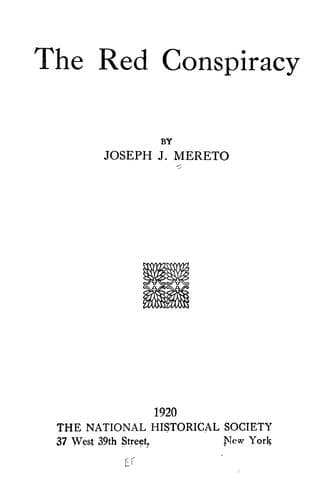
Communism; Industrial Workers of the World; Socialism
"The Socialist Party of the United States at its first national
convention after the war, squarely takes its position with the
uncompromising section of the international Socialist movement. We
unreservedly reject the policy of those Socialists who supported their
belligerent capitalist governments on the plea of 'national defense,'
and who entered into demoralizing compacts for so-called civil peace
with the exploiters of labor during the war and continued a political
alliance with them after the war. We, the organized Socialists of
America, pledge our support to the revolutionary workers of Russia in
the maintenance of their Soviet Government, to the radical Socialists of
Germany, Austria and Hungary in their efforts to establish working-class
rule in their countries, and to those Socialist organizations in
England, Italy and other countries who during the war, as after the war,
have remained true to the principles of uncompromising international
Socialism."
Just as the Moscow Manifesto cries out, "Long live the International
Republic of Proletarian Soviet!" so does Hillquit's manifesto, adopted
September 4, 1919, by the Socialist Party, "hold out to the world the
ideal of a federation of free and equal Socialist nations." A common
zeal for the violent overthrow of the world's existing non-Socialist
governments, in order to set up a world-empire of Socialism, is the
major feature of the Socialist Party's unity with the Moscow plotters
and incendiaries.
But while Moscow's "programs and methods" are "not so much" the concern
of the American Socialist Party as the "federation of ... Socialist
nations," yet these Moscow "programs and methods" are themselves also
distinctly adopted and enthusiastically followed by the American
Socialists.
The Moscow Manifesto ("New York Call," July 24, 1919) lays down two
great principles of action, one of _method_, the other of _means_. Here
is the method: "The revolutionary epoch demands that the proletariat
should employ such fighting methods as will concentrate its entire
energy, viz., the method of mass action, and lead to its logical
consequence--the direct collision with the capitalist state machine in
an open combat. All other methods, e.g., revolutionary use of bourgeois
parliamentarism, will in the revolution have only a subordinate value."
Here is the means: "A coalition is necessary with those elements of the
revolutionary workers' movement who, though they did not previously
belong to the Socialist Party, now, on the whole, take up the standpoint
of the proletarian dictatorship in the form of the power of Soviets,
e.g., _some of the sections among the Syndicalists_." (Ibid.)
Public-domain text, read in full here on John Shaqi.
Reviews
Reviews
No reviews yet
Be the first to share your thoughts on this work.
Elsewhere in the archive
Join the Discussion
Join the discussion
Sign in to leave a comment or review.
Sign InorCreate an account