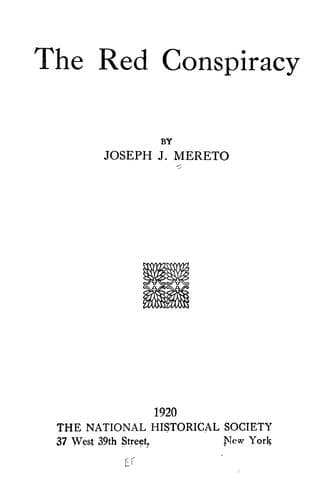
Communism; Industrial Workers of the World; Socialism
In the Socialist state great discontent would arise from either the
toleration or prohibition of small business enterprises. If permitted,
without power to hire labor, they must compete with the government. If
forbidden, large numbers of persons would be obliged to work for the
government, after losing little stores or shops in which for years they
had been interested.
In its issue of March 30, 1912, the "Appeal to Reason," then the leading
Socialist weekly of the United States, declared that under Socialism
John D. Rockefeller would be allowed to retain his money and decide what
to do with it. Were this the case, and every person of wealth allowed to
retain his money, it is difficult to see how Socialists who hate and
detest the rich could endure such a condition, any more than they could
tolerate the granting of full or partial indemnity to property owners.
The attempt to leave the rich in possession of their wealth would
probably incite Socialists to rise in arms against the state they had
founded.
On the other hand, if wealth were confiscated, the wealthy and the
honest poor alike would be discontented with a dishonest government.
Moreover, where would the Socialists draw the line of lawful possession?
At $1,000,000, $10,000, $1,000, or $100? Would the decision be reached
peaceably? Would the use and possession of government bonds be allowed?
As the desire to acquire is one of the strongest passions, bitter hatred
would assail the Socialist state, which, Debs tells us, would prohibit
business profits, rent and interest. ["Socialism and Unionism," by
Eugene V. Debs.] How could insurance companies, in which the American
people have invested so much, and which depend on interest, exist under
Socialism? Socialism having ruined the insurance companies, would the
millions of policyholders just sit down and have a good, hearty laugh
over their losses?
The real crux of Socialism is the inability of the Marxians to determine
upon a system of employment and a scale of wages or remuneration
satisfactory both to the government and the working classes.
Remuneration must either be in the form of money, or of goods or labor
certificates entitling the holder to receive goods from the government
stores. As labor certificates would be like money, we shall class them
as "money" when speaking of wages.
Different schemes of employment have been proposed by Socialists. One of
the oldest allows each individual to select the occupation he desires,
provided he can do the work. All citizens, under this system, receive
equal pay or equal supplies for their services.
Public-domain text, read in full here on John Shaqi.
Reviews
Reviews
No reviews yet
Be the first to share your thoughts on this work.
Elsewhere in the archive
Join the Discussion
Join the discussion
Sign in to leave a comment or review.
Sign InorCreate an account