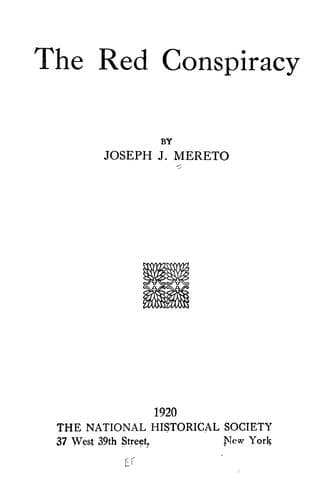
Communism; Industrial Workers of the World; Socialism
"Only through this combination of our powers can we establish the
co-operative commonwealth, wherein the workers shall own their jobs
and receive the full social value of their product. The necessities
of life will then be produced, not for the profits of the few, but
for the comfort and happiness of all who labor. Instead of
privately owned industries with masters and slaves, there will be
the common ownership of the means of life, and all the
opportunities and resources of the world will be equal and free to
all."
The fundamental principle of Socialism, namely, a government, democratic
in form, in which all the citizens would collectively own and manage the
principal means of production, transportation and communication, will be
more clearly understood if the several component parts of the basic
principle are explained.
A government, _democratic in form_, would, of course, require the
overthrow of all limited monarchies as well as the annihilation of those
that are despotic. Even a republican form of government, like that of
the United States, is very far from being satisfactory to the
Revolutionists, for they demand that the citizens have as direct a voice
as possible, first in the election of all public officers, secondly in
the framing of the laws, and thirdly in the management of the many
industrial departments of the proposed government.
By the citizens' _collective owning_ of the different things enumerated
is meant that they would own them just as the citizens of the United
States, as a body, to-day own the post-offices, arsenals, navy and
public lands. Of course, collective ownership does not imply that, after
the state should have taken over the things referred to, each citizen
would be entitled to an equal share of them as his own private property,
to be used by him according to his desires.
_The management of the property_ of the Socialist state and the
remuneration[8] for labor would not be in the hands of private
individuals acting independently, but would be subject to the will of
the majority of the citizens.
By the _principal_ means of production, transportation and communication
is meant any instrument of production, transportation or communication
that would be used for purposes of exploitation, in other words, for
making profit through the employment of hired labor. To illustrate this,
several examples will be given. Mines, factories and mills of all kinds,
large business houses and stores, together with those farms whose owners
would employ hired labor for the production of goods to be sold at
profit, would all be looked upon as being among the _principal means of
production_. On the other hand, a sewing-machine used for family needs
would not be included in the list.
Public-domain text, read in full here on John Shaqi.
Reviews
Reviews
No reviews yet
Be the first to share your thoughts on this work.
Elsewhere in the archive
Join the Discussion
Join the discussion
Sign in to leave a comment or review.
Sign InorCreate an account