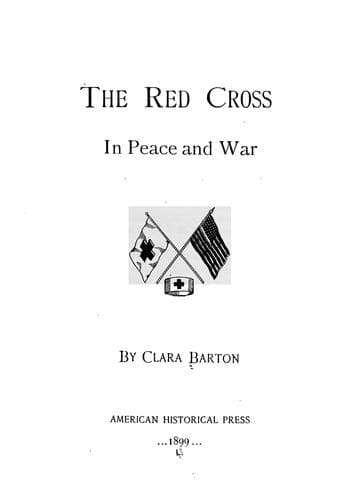
American National Red Cross; Red Cross and Red Crescent
We had employed during our sojourn in Johnstown a working force of fifty
men and women, whom we had housed, fed and paid, with the exception of
the volunteers who worked for the good they could do and would accept
nothing. The means which we so largely handled came from everywhere;
accounts were rendered for everything, and no word of business
complication ever came to us. There never has in all our work.
There was much to do in Johnstown after we left; buildings to remove and
property to care for when it had served its purpose and the ground
became needed. But there is always a right time for any benevolent work
to cease; a time when the community is ready to resume its own burdens,
and when an offered charity is an insult to the honest and independent,
and a degradation to the careless and improvident, tending to pauperize
and make them an added burden on their better-minded fellow citizens.
And then, the moment the tradesman is able to re-establish himself, he
looks with jealous eyes on any agency that diverts possible business
from his channels. Thus it is not only wise but just to all concerned to
withdraw all gratuities from a people the instant they are able to gain
even a meagre self-support.
A rather curious circumstance, somewhat on the line of this reflection,
fell to our lot after leaving Johnstown. The houses that we had built
and furnished were indispensable to the tenants during the winter, when
there were no other houses to be had; but in the spring the city,
rejuvenated, began to build up again, and we were notified that the land
on which our large houses were standing was needed by the owners, who
wished to use it for their own purposes, and they requested the Red
Cross to remove its buildings. We promptly sent an agent to attend to
the matter, and he began the work of vacating the premises. There was no
hardship involved in this, as all the tenants were by this time in
condition to pay rent, the relief fund of $1,600,000 having been
distributed among them in proportion to their losses, and there were
houses that they could get; in a few days our houses were empty. Then a
new factor entered into the situation. When it became generally known
that the Red Cross must remove these immense houses, and that a large
quantity of lumber and house furnishings were to be disposed of, the
self-interests of the dealers in those commodities were at once aroused,
and they strongly protested against the gratuitous distribution of those
articles among the people of Johnstown, asserting that the inhabitants
were now prospering and had the means to buy everything they needed, and
that a gift from us of any of these things would be an injustice to the
honest traders who were trying to re-establish themselves.
Public-domain text, read in full here on John Shaqi.
Reviews
Reviews
No reviews yet
Be the first to share your thoughts on this work.
Elsewhere in the archive
Join the Discussion
Join the discussion
Sign in to leave a comment or review.
Sign InorCreate an account