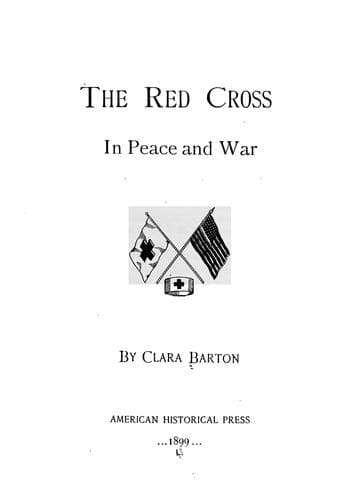
American National Red Cross; Red Cross and Red Crescent
From Aintab, Mr. Wood and Mr. Wistar started by way of the most
distressed points needing help eastward, and then north to Harpoot; and
because of your telegram of the report of typhus and dysentery at Marash
and Zeitoun, we started in that direction, with Rev. L.O. Lee, who was
returning home. After facing rain, snow and mud for three days we came
to Marash. Here we remained until our caravan of goods came on. Typhus,
dysentery and smallpox were spreading as a result of the crowded state
of the city; Marash had been filled with refugees since the November
massacres, notwithstanding a large part of its own dwelling houses had
been burned and plundered. The surrounding country had also been
pillaged, people killed and villages destroyed, and the frightened
remnant of people had crowded in here for protection, and up to this
time had feared to return. With insufficient drainage and warm weather
coming on, typhus, dysentery and smallpox already in the prisons, an
epidemic was becoming general. True, the preachers _requested mothers
not to bring children with smallpox_ to church, nevertheless the typhus
and smallpox spread, and rendered medical supervision a necessity. By
the efforts of Mrs. Lee and Mrs. Macallum, wives of the missionaries of
the Marash station, a hospital had been established with plenty of
patients, but they had no funds for physicians or medicines. Medicines
were left and funds furnished for a native doctor educated in America
(who himself had just recovered from typhus) and was placed in charge of
the hospital and out-of-door service, and was doing efficient work
before we left Marash. Arrangements were made with Rev. Mr. Macallum to
have tools and implements made and distributed to artisans and
villagers; and we left with him to begin this work the sum which you had
sent for our own use 500 lire--$23,000.
By this time Dr. Ira Harris, whom you had called from Tripoli, Syria,
with his assistants, arrived for the Zeitoun field. Dr. Harris had his
well-filled medical chests and surgical supplies in a mule caravan, and
being more needed at other places, we left immediately for Adioman via
Besnia, passing through Bazarjik and Kumaklejercle, a three days'
mountain journey. Our officer kindly told us, when we stopped at a
Kourdish village for the night, to "order what we want and not pay if we
do not want to." But we made it clear to him, that while we are not
extravagant in our wants, _we_ always pay for what we take. It is
customary in this country for villages to entertain soldiers free of
charge. At Bazarjik when we inquired concerning the health of the place,
an official said they had no sickness _except a few cases of smallpox,
and this was confined to children_--that his little girl had it, and she
was brought in as a proof.
Public-domain text, read in full here on John Shaqi.
Reviews
Reviews
No reviews yet
Be the first to share your thoughts on this work.
Elsewhere in the archive
Join the Discussion
Join the discussion
Sign in to leave a comment or review.
Sign InorCreate an account