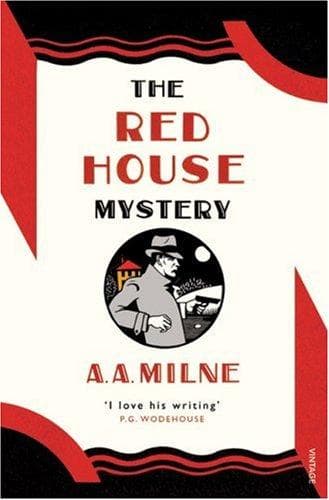
The Red House MysteryMilne, A. A. (Alan Alexander)
General
The Red House Mystery
Milne, A. A. (Alan Alexander)
Detective and mystery stories; England -- Fiction
John Borden was giving evidence. He was on the up platform seeing a
friend off by the 3.55 on Tuesday afternoon. He had noticed a man on
the platform with coat collar turned up and a scarf round his chin. He
had wondered why the man should do this on such a hot day. The man
seemed to be trying to escape observation. Directly the train came in,
he hurried into a carriage. And so on.
“There’s always a John Borden at every murder case,” said Antony to
himself.
“Have you ever seen Mark Ablett?”
“Once or twice, sir.”
“Was it he?”
“I never really got a good look at him, sir, what with his collar
turned up and the scarf and all. But directly I heard of the sad
affair, and that Mr. Ablett was missing, I said to Mrs. Borden, ‘Now I
wonder if that was Mr. Ablett I saw at the station?’ So then we talked
it over and decided that I ought to come and tell Inspector Birch. It
was just Mr. Ablett’s height, sir.”
Antony went on with his thoughts....
The Coroner was summing up. The jury, he said, had now heard all the
evidence and would have to decide what had happened in that room
between the two brothers. How had the deceased met his death? The
medical evidence would probably satisfy them that Robert Ablett had
died from the effects of a bullet-wound in the head. Who had fired that
bullet? If Robert Ablett had fired it himself, no doubt they would
bring in a verdict of suicide, but if this had been so, where was the
revolver which had fired it, and what had become of Mark Ablett? If
they disbelieved in this possibility of suicide, what remained?
Accidental death, justifiable homicide, and murder. Could the deceased
have been killed accidentally? It was possible, but then would Mark
Ablett have run away? The evidence that he had run away from the scene
of the crime was strong. His cousin had seen him go into the room, the
servant Elsie Wood had heard him quarrelling with his brother in the
room, the door had been locked from the inside, and there were signs
that outside the open window some one had pushed his way very recently
through the shrubbery. Who, if not Mark? They would have then to
consider whether he would have run away if he had been guiltless of his
brother’s death. No doubt innocent people lost their heads sometimes.
It was possible that if it were proved afterwards that Mark Ablett had
shot his brother, it might also be proved that he was justified in so
doing, and that when he ran away from his brother’s corpse he had
really nothing to fear at the hands of the Law. In this connection he
need hardly remind the jury that they were not the final tribunal, and
that if they found Mark Ablett guilty of murder it would not prejudice
his trial in any way if and when he was apprehended.... The jury could
consider their verdict.
They considered it. They announced that the deceased had died as the
result of a bullet-wound, and that the bullet had been fired by his
brother Mark Ablett.
Public-domain text, read in full here on John Shaqi.
Reviews
Reviews
No reviews yet
Be the first to share your thoughts on this work.
Elsewhere in the archive
Join the Discussion
Join the discussion
Sign in to leave a comment or review.
Sign InorCreate an account