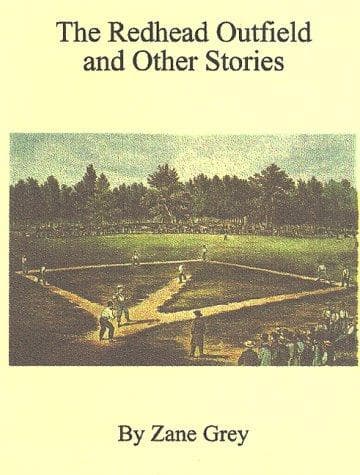
The Redheaded Outfield, and Other Baseball StoriesGrey, Zane
General
The Redheaded Outfield, and Other Baseball Stories
Grey, Zane
Baseball stories, American; Fiction; Short stories
"Lord! what whips these lads have!" exclaimed Merritt. "Hope we're not
up against it. If this team should beat us we wouldn't draw a handful
at Toronto. We can't afford to be beaten. Jump around and cinch the
game quick. If we get in a bad place, I'll sneak in the 'rabbit.'"
The "rabbit" was a baseball similar in appearance to the ordinary
league ball; under its horse-hide cover, however, it was remarkably
different.
An ingenious fan, a friend of Merritt, had removed the covers from a
number of league balls and sewed them on rubber balls of his own
making. They could not be distinguished from the regular article, not
even by an experienced professional--until they were hit. Then! The
fact that after every bounce one of these rubber balls bounded swifter
and higher had given it the name of the "rabbit."
Many a game had the "rabbit" won for us at critical stages. Of course
it was against the rules of the league, and of course every player in
the league knew about it; still, when it was judiciously and cleverly
brought into a close game, the "rabbit" would be in play, and very
probably over the fence, before the opposing captain could learn of it,
let alone appeal to the umpire.
"Fellars, look at that guy who's goin' to pitch," suddenly spoke up one
of the team.
Many as were the country players whom we seasoned and traveled
professionals had run across, this twirler outclassed them for
remarkable appearance. Moreover, what put an entirely different tinge
to our momentary humor was the discovery that he was as wild as a March
hare and could throw a ball so fast that it resembled a pea shot from a
boy's air gun.
Deerfoot led our batting list, and after the first pitched ball, which
he did not see, and the second, which ticked his shirt as it shot past,
he turned to us with an expression that made us groan inwardly.
When Deerfoot looked that way it meant the pitcher was dangerous.
Deerfoot made no effort to swing at the next ball, and was promptly
called out on strikes.
I was second at bat, and went up with some reluctance. I happened to
be leading the league in both long distance and safe hitting, and I
doted on speed. But having stopped many mean in-shoots with various
parts of my anatomy, I was rather squeamish about facing backwoods yaps
who had no control.
When I had watched a couple of his pitches, which the umpire called
strikes, I gave him credit for as much speed as Rusie. These balls
were as straight as a string, singularly without curve, jump, or
variation of any kind. I lined the next one so hard at the shortstop
that it cracked like a pistol as it struck his hands and whirled him
half off his feet. Still he hung to the ball and gave opportunity for
the first crash of applause.
"Boys, he's a trifle wild," I said to my team-mates, "but he has the
most beautiful ball to hit you ever saw. I don't believe he uses a
curve, and when we once time that speed we'll kill it."
Public-domain text, read in full here on John Shaqi.
Reviews
Reviews
No reviews yet
Be the first to share your thoughts on this work.
Elsewhere in the archive
Join the Discussion
Join the discussion
Sign in to leave a comment or review.
Sign InorCreate an account