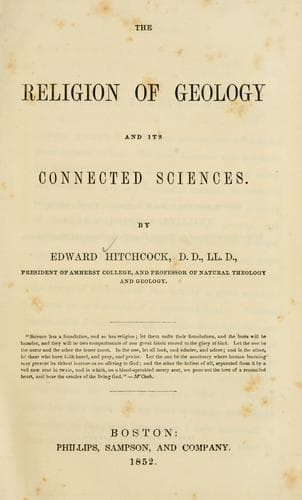
The Religion of Geology and Its Connected SciencesHitchcock, Edward
Religion
The Religion of Geology and Its Connected Sciences
Hitchcock, Edward
Bible and geology; Religion and science
"Let us now take the seat of the antediluvian population," continues Dr.
Smith, "to have been in Western Asia, in which a large district, even at
the present day, lies considerably below the level of the sea. It must not
be forgotten that six weeks of continued rain would not give an amount of
water forty times that which fell on the first, or a subsequent day, for
evaporation would be continually carrying up the water to be condensed,
and to fall again; so that the same mass of water would return many times.
If, then, in addition to the tremendous rain, we suppose an elevation of
the bed of the Persian and Indian Seas, or a subsidence of the inhabited
land towards the south, we shall have sufficient cause in the hands of
almighty justice for submerging the district, covering its hills, and
destroying all living beings within its limits, except those whom divine
mercy preserved in the ark. The drawing off of the waters would be
effected by a return of the bed of the sea to a lower level, or by the
elevation of some tracts of land, which would leave channels and slopes
for the larger part of the water to flow back into the Indian Ocean, while
the lower part remained a great lake, or an inland sea, the Caspian."--p.
217.
It is a circumstance favoring the above suggestions of Dr. Smith, that
there is a tract of country ten degrees of latitude in breadth, embracing
most of Asia Minor, ancient Armenia and Georgia, and part of Persia,
extending at least as far east as the Caspian Sea, and probably much
farther, in which volcanic agency has been in operation at a comparatively
recent period. I am not aware that we have evidence of any eruption of
lava in those regions, within historic times, except, perhaps, some mud
volcanoes in the Caucasian range. The Katekekaumene, or Burnt District, of
Asia Minor, and Mount Ararat, probably experienced eruptions at a date
somewhat earlier, though at a comparatively recent date. Yet important
changes of level may have been the result of volcanic agency in Central
Asia, as recently as the Noachian deluge, without leaving any traces which
would be obvious, without more careful observation than has yet been made
in those regions. Especially might a subsidence of the surface have taken
place, and not have left any striking evidence of its occurrence. Still
more difficult would it now be to discover the marks of vertical movements
in the bed of the Indian Ocean at the time of the deluge.
I will venture to add another suggestion. If the bed of the Indian Ocean
was uplifted by volcanic matter, struggling to get vent, vapor enough
might have been liberated to account, on natural principles, for the forty
days' rain of the deluge. For it is well known that in volcanic eruptions
drenching rains are often the result of the sudden condensation of the
aqueous vapor.
Public-domain text, read in full here on John Shaqi.
Reviews
Reviews
No reviews yet
Be the first to share your thoughts on this work.
Elsewhere in the archive
Join the Discussion
Join the discussion
Sign in to leave a comment or review.
Sign InorCreate an account