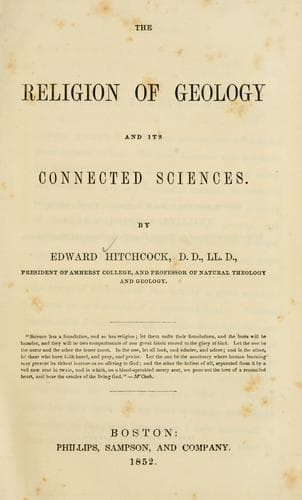
The Religion of Geology and Its Connected SciencesHitchcock, Edward
Religion
The Religion of Geology and Its Connected Sciences
Hitchcock, Edward
Bible and geology; Religion and science
Let me not be thought to be an advocate in any sense for the unsupported
notion of an infinite series of organic beings. But the question is,
whether those who, in spite of common sense, have maintained this opinion,
have been fairly refuted by such metaphysical evasions as I have quoted.
The truth is, that, in order to end this dispute, the Theist needs to
bring forward at least one example in which the commencement of some race
of animals can be fairly pointed out; and I know not where such an example
can be found, save in the Bible and geology.
In the fifth place, the changing state of the world has been regarded as
incompatible with the world's eternity. This argument is thus stated by
Bishop Sumner: "If the universe itself is the first eternal being, its
existence is necessary, as metaphysicians speak; and it must be possessed
of all those qualities which are inseparable from necessary existence. Of
this nature are immutability and perfection. For change is the attribute
of imperfection, and imperfection is incompatible with that Being, which
is, as the hypothesis affirms, independent, and, therefore, can have no
source of imperfection. To suppose, therefore, of the first independent
Being, that it could have existed otherwise than it is, is no less
contrary to the idea of necessity, with which we set out, than to suppose
it not to exist at all."
This reasoning is not destitute of plausibility. For there is scarcely any
lesson more forcibly impressed on short-lived man than the mutability of
the world. And it is indeed true that change is its most striking
attribute. But when we look at the subject philosophically, we find that
all this mutability is consistent with the most perfect ultimate
stability; nay, that the change is essential to secure the stability.
Apart from what revelation and geology teach, these changes in nature form
cycles, which, like those in astronomy, are perfectly consistent with the
eternal permanence of the general system to which they belong. In the
motions of the heavenly bodies, a considerable amount of irregularity and
oscillation about a mean state does not tend to the ruin, but rather to
the preservation, of the system, provided the anomalies do not extend
beyond certain limits. It is just so with other changes that are going on
around us. All of them are, in fact, as much regulated by mathematical
laws as the perturbations of the heavenly bodies; although those laws are
more complicated and difficult to bring out in distinct formulae in the
former case than in the latter. Yet even in astronomy, it is not many
years since the mutual disturbances among the heavenly bodies were
supposed to be the certain precursors of ruin to the system. It was not
till the famous problem of the three bodies was solved, by the use of the
most refined mathematical analysis, that astronomers learnt the true
operation of those causes of disturbance among the heavenly bodies which
exist in their mutual attractions.
Public-domain text, read in full here on John Shaqi.
Reviews
Reviews
No reviews yet
Be the first to share your thoughts on this work.
Elsewhere in the archive
Join the Discussion
Join the discussion
Sign in to leave a comment or review.
Sign InorCreate an account