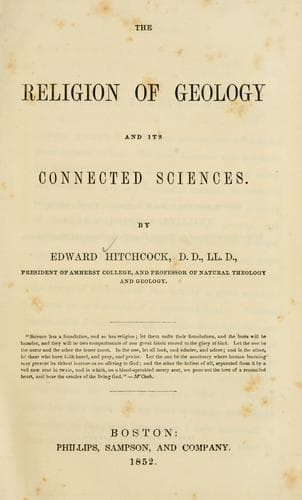
The Religion of Geology and Its Connected SciencesHitchcock, Edward
Religion
The Religion of Geology and Its Connected Sciences
Hitchcock, Edward
Bible and geology; Religion and science
Atmospheric and aqueous changes often, and, indeed, generally, appear more
chaotic and destitute of a controlling force than any others in nature.
When the winds are let loose from their prison-house; when the heavens
become dark, and the clouds, rent by the lightnings, pour down their
contents, and the swollen torrents carry desolation down the mountain's
side and over the wide plain; when the ocean rolls in upon the land its
giant waves; when the tornado sweeps all before it, in rich tropical
regions; or when the sirocco sends its hot blast, loaded with sand, over
the devoted surface,--in all these cases, how difficult for us to conceive
that all this uproar among the elements is limited and controlled by laws
as fixed and unalterable as those which regulate the heavenly bodies!
Nevertheless, it must be so; and although the winds and the waters seem to
be rioting at their pleasure, there are, in fact, at work antagonist
agencies; which will confine their wild war to a narrow field, and soon
bring them again into peaceful submission. For such has always been the
case, and the limits of their irregularities are no wider now than six
thousand years ago. In other words, the repressing agency has always been
superior to the destroying force, when the latter has risen to a certain
limit; and I doubt not but the profounder mathematics of angelic minds
might as easily calculate the anomalies and perturbations of winds and
waves as the formulas of La Place can determine those of the solar system.
And if such constancy has existed for six thousand years in meteorological
changes,--of all others in nature apparently the most irregular,--why, the
atheist will ask, may not that constancy have been eternal? And with equal
reason may he ask the same in respect to all changes resulting from
mechanical, chemical, and organic laws, which we witness in nature, except
those which come within the province of geology, and even concerning some
of those; and what changes in the material world do not result, directly
or remotely, from one or two, or all of these laws? Yet, in regard to all
these changes, there is no inconsistency in supposing them to have gone on
in an eternal series; and hence they furnish no proof of the non-eternity
of the world.
In the seventh and last place, the recent origin of society, as shown by
historical monuments, is regarded as evidence of the recent origin of the
world. This argument was well understood as long ago as the days of
Lucretius, who states it very clearly in the oft-quoted lines,--
"Si nulla fuit genitalis origo,
Terrarum et coeli, semperque eterna fuit,
Cur, supra bellum Thebanum et funera Trojae,
Non alias alii quoque res cecinere poetae?"
Public-domain text, read in full here on John Shaqi.
Reviews
Reviews
No reviews yet
Be the first to share your thoughts on this work.
Elsewhere in the archive
Join the Discussion
Join the discussion
Sign in to leave a comment or review.
Sign InorCreate an account