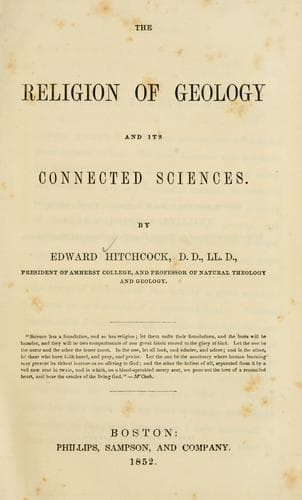
The Religion of Geology and Its Connected SciencesHitchcock, Edward
Religion
The Religion of Geology and Its Connected Sciences
Hitchcock, Edward
Bible and geology; Religion and science
In the first place, we may derive from science some presumptive proof of a
commencement of the matter of the universe. The fact that the organic
races on the globe had a beginning affords such proof. For matter could
not have originated itself; nor is there any proof of its eternal
existence; and to assume that it did eternally exist, without proof, is
far more unphilosophical than to admit its origination in the divine will.
For since God has complete control over matter, it is probable that he
created it with such properties as he wished it to possess. And
furthermore, to the power and wisdom that could set in motion the heavenly
bodies, and create and adapt existing organisms out of preexistent matter,
we can assign no limits, and hence conclude them to be infinite.
Therefore they are sufficient to the production of matter, which could not
have demanded more than infinite wisdom and power.
Now, in confirmation of these presumptions, we may appeal to the Bible. It
is true that writers have been accustomed to consider it contrary to sound
logic to draw from revelation any support or illustrations of natural
religion. But why should an historical fact possess less value, if
transmitted to us through the channel of sacred, rather than profane,
writers? Now, it would be regarded as perfectly good reasoning to seize
upon any facts stated by heathen philosophers and historians, illustrative
of natural religion. But the Scriptures carry with them, to say the least,
quite as strong evidence of their authenticity and claims to be credited,
as any ancient uninspired writer. We place them on the same ground as any
other history, and demand for them only that they should be believed so
far as we have testimony to their authenticity. If a man, after careful
examination of their evidences, comes to the conclusion that they are mere
fables, then to him their testimony is of no value to prove or illustrate
any truth of natural religion. But if he is convinced that they are worthy
of credence, then their statements may decide a point about which the
light of nature leaves him in uncertainty. In this way the Bible is used
by the natural theologian, just as he would employ any curious object in
nature--say, the human hand, or the eye. These organs exist, and their
mechanism is to be accounted for either with or without a God. And so the
Bible exists, and its contents are to be accounted for; and if they
clearly evince the agency of a Deity, then we may use them, just as we
would use the eye or the hand, to prove or illustrate important truths in
natural theology.
Public-domain text, read in full here on John Shaqi.
Reviews
Reviews
No reviews yet
Be the first to share your thoughts on this work.
Elsewhere in the archive
Join the Discussion
Join the discussion
Sign in to leave a comment or review.
Sign InorCreate an account