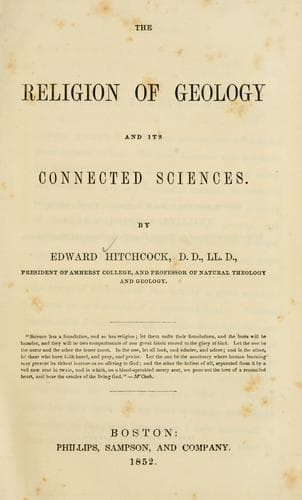
The Religion of Geology and Its Connected SciencesHitchcock, Edward
Religion
The Religion of Geology and Its Connected Sciences
Hitchcock, Edward
Bible and geology; Religion and science
Secondly. The subject presents us with a new argument for the existence of
a God, or rather a satisfactory modification of the argument from design.
In that argument, as derived from other sciences, the Theist finds,
indeed, multiplied and beautiful proofs of adaptation and apparent design;
but then he cannot, as already observed, from those sciences derive proof
of the commencement either of matter or its arrangements; and then, too,
the sceptic, with plausible ingenuity, can take his stand upon law as the
efficient agent in nature's movements and harmonies. But when geology
shows us, not the commencement of matter, but of organism, and presents us
with full systems of animals and plants springing out of inorganic
elements, where is the law that exhibits even a tendency to such results?
Nothing can explain them but the law of miracles; that is, creation by
divine interposition. Thus is the idea of a Deity forced nakedly upon us,
as the only possible solution of the enigmas of creation. The
metaphysical Theist must waste half his strength in battling the
questions about the beginning of matter, and the laws of matter; nor can
he ever entirely dislodge the enemy from these strongholds of atheism. But
the geological Theist takes us at once into a field where work has been
done, which neither eternal law, nor eternal matter, but an infinite
personal Deity only, could accomplish.
In conclusion, I would merely refer to the interesting fact, that geology
should prove almost the only science that presents us with exigencies
demanding the interposition of creating power. And yet, up to the present
time, geology has been looked upon by many Christian writers with jealous
eye, because it was supposed to teach the world's eternity, and so to
account for natural changes by catastrophes and the gradual operation of
existing agencies, as to render a Deity unnecessary, either for the
creation or regulation of the world. One of these writers has even most
uncharitably and unreasonably said, that "the mineral geology, considered
as a science, can do as well without God (though in a question concerning
the origin of the earth) as Lucretius did."--Granville Penn, _Comparative
Estimate_, &c.--How much ground there is for such an allegation, let the
developments made in this lecture answer. Surely, in this case, geology
has followed the directions of the Oriental poet:--
"Learn from yon Orient shell to love thy foe,
And strew with pearls the hand that brings thee woe;
Free, like yon rock, from base, vindictive pride,
Emblaze with gems the wrist that rends thy side.
Mark where yon tree rewards the stony shower
With fruit nectareous or the balmy flower.
All nature calls aloud,--'Shall man do less
Than heal the smiter, and the railer bless?'"
Public-domain text, read in full here on John Shaqi.
Reviews
Reviews
No reviews yet
Be the first to share your thoughts on this work.
Elsewhere in the archive
Join the Discussion
Join the discussion
Sign in to leave a comment or review.
Sign InorCreate an account