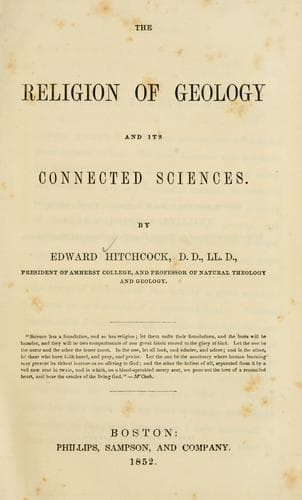
The Religion of Geology and Its Connected SciencesHitchcock, Edward
Religion
The Religion of Geology and Its Connected Sciences
Hitchcock, Edward
Bible and geology; Religion and science
Passing over to the Isle of Wight, and traversing its shores, we shall
witness many unique examples of natural beauty, swelling sometimes into
sublimity,--such are the chalk cliffs near its western extremity, from two
hundred to six hundred feet high,--sometimes hollowed out into magnificent
domes, and the pillars of chalk, called _Needles_, in the midst of the
sea, alive with sea gulls and cormorants, and forming the remnants of the
chalk bridge that once united the island to England. There, too, Alum Bay,
with its many-colored strata of clay, unites the interesting in geology
with the picturesque in scenery.
Along the southern coast, also, are the stupendous cliffs and the romantic
under-cliffs, as well as the ragged _chines_, where an almost tropical
climate attracts the invalid, while the cool sea breezes draw thither the
wealthy and the fashionable.
But if sublime scenery pleases us more, we must traverse the Highlands of
Scotland,--
"Land of brown heath and shaggy furze,"
land of lofty and naked mountains, embosoming lakes of great beauty, and
full of historic and poetic interest.
Passing over Loch Lomond, the queen of Scottish lakes, you go through the
long shadow of Ben Lomond, propped by many lesser mountains. Rising into
the Highlands, the sterility and wildness increase, and reach their
maximum in Glencoe, whose wildness and sublimity are indeed indescribable;
but if seen, they can never be forgotten. Still farther north, Ben Nevis
lifts its uncovered head above all other mountains in the British Isles;
so high, indeed, that often, during the whole summer, it retains a portion
of its snowy, wintry mantle.
Yet farther north, we come to the unique terraces, called the _Parallel
Roads of Glen Roy_, formerly supposed to be the work of giants; but now,
that they are known to be the product of nature, proving not only objects
of great scenographical interest, but a problem of special importance and
difficulty in geology.
If we should pass from Scotland to the north-east part of Ireland, taking
Staffa in our way, we should find in the basaltic columns of Fingal's
Cave, and the Giant's Causeway, what seems, at first view, to be
stupendous human structures, or rather the architecture of giants. But you
soon find it to be only an example--
"Where nature works as if defying art,
And, in defiance of her rival powers,
By these fortuitous and random strokes,
Performing such inimitable feats,
As she, with all her rules, can never reach."
Public-domain text, read in full here on John Shaqi.
Reviews
Reviews
No reviews yet
Be the first to share your thoughts on this work.
Elsewhere in the archive
Join the Discussion
Join the discussion
Sign in to leave a comment or review.
Sign InorCreate an account