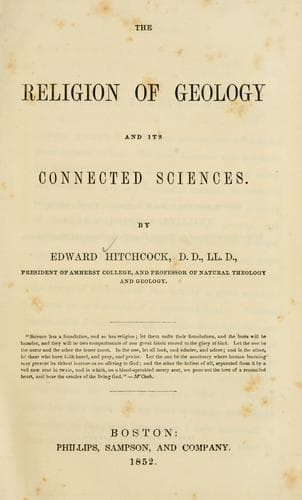
The Religion of Geology and Its Connected SciencesHitchcock, Edward
Religion
The Religion of Geology and Its Connected Sciences
Hitchcock, Edward
Bible and geology; Religion and science
Embark, for instance, at Zurich, and, crossing its beautiful lake, direct
your course towards Mount Righi. As the heavy diligence lifts you above
the lake, you begin to catch glimpses of the grandeur of the Swiss
mountains to the south, piercing the clouds far off. Passing the romantic
Zug, you come to the valley between the Rossberg and the Righi, and the
denuded face of the former tells you whence came the mass of ruins over
which you clamber, and which buried the villages of Goldau, Bussingen, and
Rothen several hundred feet deep with blocks of stone and soil. Long and
steep is your ascent of Righi, nearly six thousand feet above the sea. But
the views you obtain by the way become wider and grander at every step.
Reaching the summit near sunset, you may be gratified by a panoramic view
of a large part of Switzerland, embracing its wildest and grandest
scenery. Yet, if the clouds prevent, you wait for the morning, in the hope
of being more fortunate. With the earliest dawn you awake, and proceed to
the summit of the mountain, where hundreds, perhaps, from all civilized
lands, are congregated, to witness the rising of the sun. But a dense
cloud envelops the mountain, and hope almost dies within you. Wait,
however, a few moments, and the rising sun will depress the clouds below
the mountain's summit, and a scene of glory shall open upon you, which can
never be erased from your memory. Look now, for the sun's first rays have
shed a flood of glory over the clouds which now fill the valleys beneath
your feet. A fleecy white predominates; but the colors of the prism tinge
the edges of the clouds, and no part of the solid earth rises above them,
save the pinnacle on which you stand, and to the south the higher peaks of
the Bernese Alps,--the Jungfrau, the Eiger, the Shreckhorn, and the
Wetterhorn,--covered with snow and glaciers, and seeming too pure to
belong to earth. Indeed, the whole scene seemed to me to be unearthly; the
fittest emblem that my eyes ever rested upon of celestial scenes; and one
cannot repress the desire, when looking upon it, to be borne away on wings
over the glorious scene, and to repose for a time upon the gorgeous bed,
forgetful of the lower world. Yet when, at length, the clouds begin to
break away, and disclose the deep valleys and blue lakes,--places made
immortal by the deeds of such patriots and reformers as Tell and
Zuinglius,--we feel again the attractions of earth; and as we descend to
Lake Lucerne, we have before us such scenery as scarcely any other part of
the world can furnish. And these scenes continue, in ever-changing
aspects, wherever we wander along this enchanting lake; and though the
exhausted brain fails at length, the objects of interest do not.
Public-domain text, read in full here on John Shaqi.
Reviews
Reviews
No reviews yet
Be the first to share your thoughts on this work.
Elsewhere in the archive
Join the Discussion
Join the discussion
Sign in to leave a comment or review.
Sign InorCreate an account