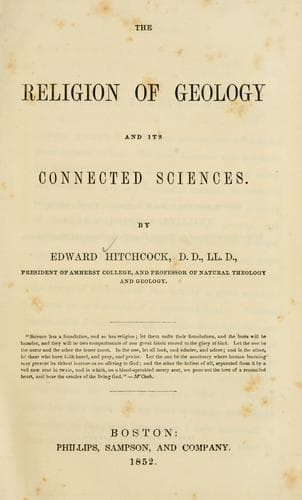
The Religion of Geology and Its Connected SciencesHitchcock, Edward
Religion
The Religion of Geology and Its Connected Sciences
Hitchcock, Edward
Bible and geology; Religion and science
It can hardly be doubted, by the geologist, that nearly every part of the
earth's crust, and its interior too, have been some time or other in a
melted state. Now, as the metals and their ores are usually heavier than
other rocks, we should expect that they would have accumulated at the
centre of the globe, and have been enveloped by the rocks so as to have
been forever inaccessible to man. And the very great weight of the central
parts of the earth--almost twice that of granite--leads naturally to the
conclusion that the heavier metals may be accumulated there, though this
is by no means a certain conclusion; since at the depth of thirty-four
miles air would be so condensed by the pressure of the superincumbent mass
as to be as heavy as water; water at the depth of three hundred and
sixty-two miles would become as heavy as quick-silver; and at the centre
steel would be compressed into one fourth, and stone into one eighth, of
its bulk at the surface. Still it is most probable that the materials
naturally the heaviest would first seek the centre. And yet, by means of
sublimation, and expansion by internal heat, or the segregating power of
galvanic action, or of some other agents, enough of the metals is
protruded towards the surface, and diffused through the rocks in beds, or
veins, so as to be accessible to human industry. Here, then, we find
divine benevolence, apparently in opposition to gravity, providing for
human comfort.
I have said that these metals were accessible to human industry. And it
does require a great deal of labor, and calls into exercise man's highest
ingenuity to obtain them. They might have been spread in immense masses
over the surface; they might all have been reduced to a metallic state in
the great furnace, which we have reason to suppose is always in blast,
within the earth. But then there would have been no requisition upon the
exertion and energy of man. And to have these called into exercise is an
object of greater importance to society than to supply it with the metals.
God, therefore, has so distributed the ores as to stimulate man to explore
and reduce them, while he has placed so many difficulties in the way as to
demand much mental and physical effort for their removal. Man now,
therefore, receives a double benefit. While the metals themselves are of
immense service, the discipline of body and mind requisite for obtaining
them is of still greater value. This is the combined result of infinite
wisdom and benevolence.
Public-domain text, read in full here on John Shaqi.
Reviews
Reviews
No reviews yet
Be the first to share your thoughts on this work.
Elsewhere in the archive
Join the Discussion
Join the discussion
Sign in to leave a comment or review.
Sign InorCreate an account