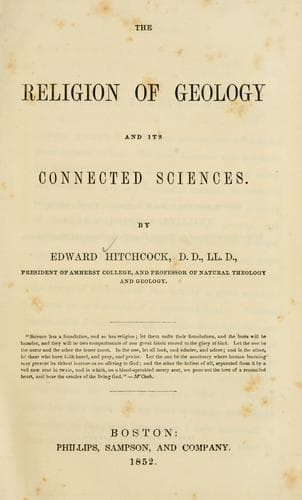
The Religion of Geology and Its Connected SciencesHitchcock, Edward
Religion
The Religion of Geology and Its Connected Sciences
Hitchcock, Edward
Bible and geology; Religion and science
In northern countries, and perhaps in high southern latitudes, it seems
that after the deposition of the tertiary rocks, and after the surface had
assumed essentially its present shape, it was subjected for a long time to
a powerful agency, whereby the rough and salient parts were worn down and
rounded, the rocks in place smoothed and furrowed, valleys scooped out,
huge blocks of stone transported far from the parent bed, piled up, and
thick accumulations of bowlders, sand, and gravel, strewn promiscuously
over the surface. At the commencement of this process, the ocean, probably
loaded with ice, stood above a large part of the present continents. It
soon began to subside, or the land to rise, and a more quiet action
succeeded. The joint action of the ocean and the glaciers on the land
ground down into sand, clay, and loam, the coarser drift, and sorted it in
the form of beaches, terraces, and alluvial deposits. All this while, both
the land and the water seem to have been, for the most part, destitute of
inhabitants. But these were the very processes needed for man and his
contemporary races, who were to appear during the latter part of the
pleistocene period. In other words, the soils were thus got ready for
nourishing the vegetation necessary to sustain the new creation, which
would convert these desolate and deserted sea-beds into regions of
fertility and happiness to teeming millions.
Now, just consider what must have been the effect of these mighty aqueous
and glacial agencies upon the earth's surface. Over the level regions they
strewed the finer materials; and where the rocks had been thrown up into
ridges and displaced by numerous fissures, or subsequently worn into
bluffs and precipices by the ocean, it needed just such an agency to
smooth down those irregularities, to fill up those gulfs, to give to the
hills and valleys a graceful outline, and to cover all the surface with
those comminuted materials that would need only cultivation to make them a
fertile soil. Some rocks do, indeed, decompose and form soils; but this
process would be too slow, unless in moist and warm regions, where it is
easier to find a footing for plants than in climes more uncongenial to
their growth. We cannot then hesitate to regard this tremendous agency of
ice and water in northern and high southern regions as decidedly
beneficial in its influence. It must, indeed, have spread terrible
destruction over those regions. But it seems that a time was chosen for
its operation when the globe was almost destitute of organic life, and not
long before the time when a new and nobler creation than those previously
occupying the earth was to be placed upon it. Desolating as this agency
must have appeared, and actually was, at the time, yet who can doubt, when
we see the ultimate fruits of it, that its origin was divine benevolence?
Public-domain text, read in full here on John Shaqi.
Reviews
Reviews
No reviews yet
Be the first to share your thoughts on this work.
Elsewhere in the archive
Join the Discussion
Join the discussion
Sign in to leave a comment or review.
Sign InorCreate an account