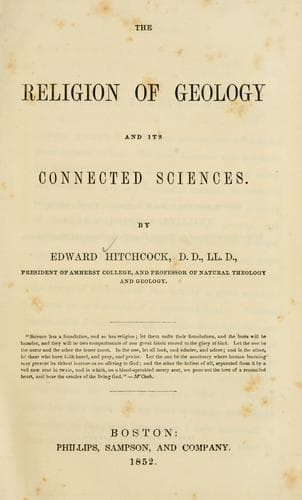
The Religion of Geology and Its Connected SciencesHitchcock, Edward
Religion
The Religion of Geology and Its Connected Sciences
Hitchcock, Edward
Bible and geology; Religion and science
some that told him of the Galileans, whose blood Pilate had mingled with
their sacrifices_. _Suppose ye_, answered the Savior, _that these
Galileans were sinners above all the Galileans, because they suffered such
things? I tell you nay. Or those eighteen, upon whom the tower of Siloam
fell and slew them, think ye that they were sinners above all men that
dwelt in Jerusalem? I tell you nay._ Let us follow the example of Jesus
Christ, and take a more enlarged view of these startling and distressing
events. Let us inquire whether they are not the incidental effects of
agencies essential to the permanence and happiness of the great system of
the universe. This is certainly the case in regard to volcanoes. We have
strong reason to believe that they are essential to the preservation of
the globe; and of how much higher consequence is this than the
comparatively small amount of property and life which they destroy! If we
can only rise to these higher views, and not suffer our judgment to be
warped by the immediate terrors of the earthquake and the volcano, we
shall see the smile of infinite benevolence where most men see only the
wrath of an offended Deity.
_My seventh geological argument for the divine benevolence is derived from
the manner in which coal, rock salt, marble, gypsum, and other valuable
materials were prepared for the use of man, long before his existence._
If a created and intelligent being from some other sphere had alighted on
this globe during that remote period when the vegetation now dug out of
the coal formation covered the surface with its gigantic growth, he might
have felt as if here was a waste of creative power. Vast forests of
sigillaria, lepidodendra, coniferae, cycadeae, and tree ferns would have
waved over his head, with their imposing though sombre foliage, while the
lesser tribes of calamites and equisetaceae would have filled the
intervening spaces; but no vertebral animal would have been there to
enjoy and enliven the almost universal solitude. Why, then, he must have
inquired, is there such a profusion of vegetable forms, and such a
colossal development of individual plants? To what use can such vast
forests be applied? But let ages roll by, and that same being revisit our
world at the present time. Let him traverse the little Island of Britain,
and see there fifteen thousand steam engines moved by coal dug out of the
earth, and produced by these same ancient forests. Let him see these
engines performing the work of two millions of men, and moving machinery
which accomplishes what would require the unaided labors of three or four
hundred millions of men, and he could not doubt but such a result was one
of the objects of that rank vegetation which covered the earth ere it was
fit for the residence of such natures as now dwell upon it. Let him go to
the coal fields of other countries, and especially those of the United
States, stretching over one hundred and fifty thousand square miles,
Public-domain text, read in full here on John Shaqi.
Reviews
Reviews
No reviews yet
Be the first to share your thoughts on this work.
Elsewhere in the archive
Join the Discussion
Join the discussion
Sign in to leave a comment or review.
Sign InorCreate an account