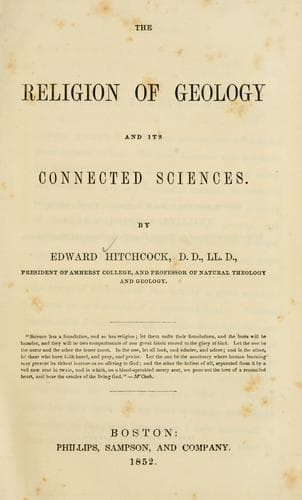
The Religion of Geology and Its Connected SciencesHitchcock, Edward
Religion
The Religion of Geology and Its Connected Sciences
Hitchcock, Edward
Bible and geology; Religion and science
We have evidence, also, of the same identity in the laws of life, or
organic laws. In the anatomical structure of the earliest animals and
plants we find the same general type that pervades the present creation,
modified only, as it now is, to meet peculiar circumstances. This is true
not only of the osseous, but also of the muscular, circulatory, nervous,
lymphatic, and nutritive organs. Hence, as we might expect, we have
evidence of the prevalence of the same functional or physiological laws
then, as now. Respiration was performed, as it now is, and with the same
effects. Vegetable and animal food was then, as now, masticated, digested,
and assimilated; and since animals possessed the same senses, we infer
that their habits were essentially the same. There is not, indeed, any
evidence that ancient animals and plants exhibited any peculiarities of
structure or function, save those necessary to adapt them to the
circumstances, so unlike the present, in many respects, in which they
lived.
We are sure, also, that death has ever reigned over all organic nature. It
has always been produced by the same causes, and attended by the same
suffering. And its ravages were repaired by the same system of
reproduction as now exists. All this we might presume would be the case,
upon the discovery of an identity of laws, mechanical, chemical, and
organic; but we have direct evidence, also, in the countless remains of
animals and plants entombed in the rocks, more than twenty thousand
species of which have been disinterred by naturalists and described.
I might multiply facts almost without number to sustain the position, that
the same mixed system has ever prevailed upon the globe; for geology is
full of the details. But in a subsequent lecture, the subject will be more
amply discussed.
Such are the facts respecting the divine benevolence, as they are
presented in the volume of nature. Though benevolence decidedly
predominates, it is modified by other divine attributes, and ever has
been, since organic existence began upon the globe. Let us now, _in the
fourth place, see what inferences are fairly deducible from the whole
subject_. For those inferences, if I mistake not, will not only clear away
every cloud from the divine benevolence, but throw much light upon man's
condition.
In the first place, the subject shows us that the world is not in a state
of retribution.
As a general fact, virtue is to some extent rewarded, and vice to some
extent punished. But it is not always so. Indeed, the picture is sometimes
reversed apparently; and the good are afflicted because they do good, and
the wicked triumph because they do evil. Evil abounds, but it is not so
distributed as righteous retribution would award it; neither is good.
Since, therefore, God's justice must be infinitely perfect, there must be
some other object for the prevalence of good and evil in the world besides
righteous retribution.
Public-domain text, read in full here on John Shaqi.
Reviews
Reviews
No reviews yet
Be the first to share your thoughts on this work.
Elsewhere in the archive
Join the Discussion
Join the discussion
Sign in to leave a comment or review.
Sign InorCreate an account