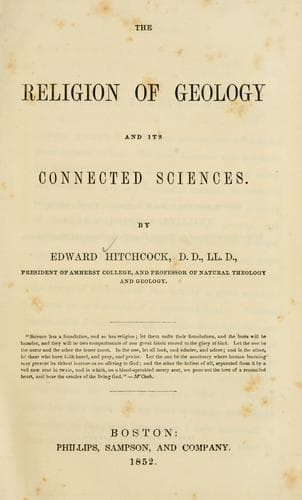
The Religion of Geology and Its Connected SciencesHitchcock, Edward
Religion
The Religion of Geology and Its Connected Sciences
Hitchcock, Edward
Bible and geology; Religion and science
Contrivance, adaptation, and design are some of the most striking features
of the natural world. They are obvious throughout the whole range of
creation, in the minutest as well as in the most magnificent objects; in
the most complicated as well as in the most simple. So universally present
are they, that whenever we meet with any thing in nature which seems
imperfectly adapted to other objects, as the organ of an animal or plant,
which exhibits malformation, it excites general attention, and the mere
child need not be told that, in its want of adaptation to other objects,
it is an exception in the natural world.
In order to illustrate what I mean by contrivance, adaptation, and design,
let me refer to a familiar example--the human eye. Made up of three coats
and three humors, of solids and fluids, of nerves, blood-vessels, and
muscles, and rivalling the most perfect optical instrument, it must have
required the most consummate contrivance to give the requisite quantity
and position to parts so numerous and unlike, for producing the phenomena
of vision. Yet how perfectly it is done! How few, out of the hundreds of
millions of eyes of men and other animals, fail of vision through any
natural defect!
No less marvellous are the adaptations of the eye. In order to be adapted
to the wonderful effect which we call light, its coats and humors must be
transparent, and possess a certain density and opacity, that the rays may
form an image on the retina. Yet to prevent confusion in the image, the
transparency must be confined to the central parts of the eye, and a dark
plexus of veins and muscles must be so situated as to absorb the
scattering rays. In order to adapt the eye to different distances, and to
the greater or less intensity of the light, delicate muscles must be so
situated as to contract and dilate the pupil, and lengthen and shorten the
axis. That the eye might be directed to different objects, strong muscles
must be attached to its posterior surface; and that the eyelid might
defend it from injuries in front, a very peculiar muscle must give it
power to close. No less perfect is the adaptation of the eye to the
atmosphere, or, rather, there is a mutual adaptation; and it is as proper
to say that the atmosphere is adapted to the eye, as that the eye is
adapted to the atmosphere. In like manner, there is a striking relation
between the eye and the sun and other heavenly bodies, and between the eye
and day and night; so that we cannot doubt but they were made for one
another. We might, indeed, extend the relations of the eye to every object
in the universe; and the same may be said of every organ of plants and
animals. The adaptation between them is as wide as creation. And it is the
wonderful harmony between so many millions of objects that makes us feel
that infinite wisdom alone could have produced it.
Public-domain text, read in full here on John Shaqi.
Reviews
Reviews
No reviews yet
Be the first to share your thoughts on this work.
Elsewhere in the archive
Join the Discussion
Join the discussion
Sign in to leave a comment or review.
Sign InorCreate an account