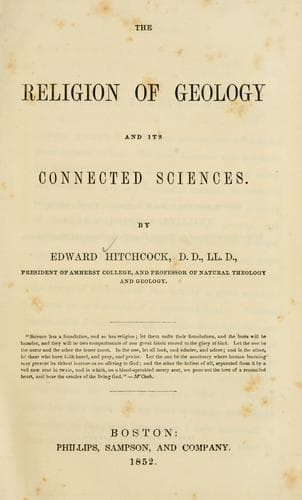
The Religion of Geology and Its Connected SciencesHitchcock, Edward
Religion
The Religion of Geology and Its Connected Sciences
Hitchcock, Edward
Bible and geology; Religion and science
It had long been known that the organs of animals were beautifully adapted
to perform the functions for which they were intended. But it was not till
the investigations of Baron Cuvier, within the last half century, that it
was known how mathematically exact is the relation between the different
parts of the animal frame, nor how precise are the laws of variation in
the different species, by which they are fitted to different elements,
climates, and food. It is now well known, that each animal structure
contains a perfect system of correlation, and yet the whole forms a
harmonious part of the entire animal system on the globe. But the
language of Cuvier himself will best elucidate this subject, so far as it
is capable of popular explanation.
"Every organized individual," says he, "forms an entire system of its own;
all the parts of which mutually correspond, and concur to produce a
certain definite purpose, by reciprocal reaction, or by combining towards
the same end. Hence none of these separate parts can change their forms
without a corresponding change in the other parts of the same animal, and
consequently each of these parts, taken separately, indicates all the
other parts to which it has belonged. Thus, if the viscera of any animal
are so organized as only to be fitted for the digestion of recent flesh,
it is also requisite that the jaws should be so constructed as to fit them
for devouring prey; the claws must be constructed for seizing and tearing
it to pieces; the teeth for cutting and dividing its flesh; the entire
system of the limbs, or organs of motion, for pursuing and overtaking it;
and the organs of sense, for discovering it at a distance. Nature, also,
must have endowed the brain of the animal with instinct sufficient for
concealing itself, and for laying plans to catch its necessary victims.
"In order that the jaw may be well adapted for laying hold of objects, it
is necessary that its condyle should have a certain form; that the
resistance, the moving power, and the fulcrum, should have a certain
relative position with respect to each other, and that the temporal
muscles should be of a certain size; the hollow, or depression, too, in
which these muscles are lodged, must have a certain depth; and the
zygomatic arch, under which they pass, must not only have a certain degree
of convexity, but it must be sufficiently strong to support the action of
the masseter.
"To enable the animal to carry of its prey when seized, a corresponding
force is requisite in the muscles which elevate the head; and this
necessarily gives rise to a determinate form of the vertebrae, to which
these muscles are attached, and of the occiput into which they are
inserted.
Public-domain text, read in full here on John Shaqi.
Reviews
Reviews
No reviews yet
Be the first to share your thoughts on this work.
Elsewhere in the archive
Join the Discussion
Join the discussion
Sign in to leave a comment or review.
Sign InorCreate an account