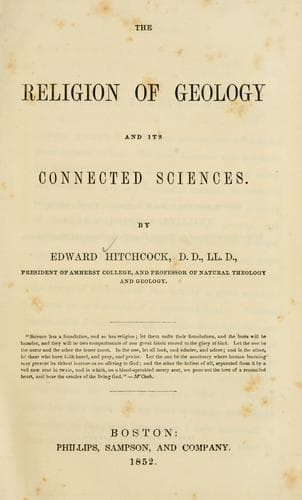
The Religion of Geology and Its Connected SciencesHitchcock, Edward
Religion
The Religion of Geology and Its Connected Sciences
Hitchcock, Edward
Bible and geology; Religion and science
"After these observations it will easily be seen that similar conclusions
may be drawn with respect to the hinder limbs of carnivorous animals,
which require particular conformations to fit them for rapidity of motion
in general; and that similar considerations must influence the forms and
connections of the vertebrae and other bones constituting the trunk of the
body, and to fit them for flexibility and readiness of motion in all
directions. The bones, also, of the nose, of the orbit, and of the ears,
require certain forms and structures to fit them for giving perfection to
the senses of smell, sight, and hearing, so necessary to animals of prey.
In short, the shape and structure of the teeth regulate the forms of the
condyle, of the shoulder-blade, and the claws, in the same manner as the
equation of a curve regulates all its other properties; and as, in regard
to a particular curve, all its properties may be ascertained by assuming
each separate property as the foundation of a particular equation, in the
same manner a claw, a shoulder-blade, a condyle, a leg, an arm bone, or
any other bone, separately considered, enables us to discover the
description of teeth to which they have belonged; and so, also,
reciprocally, we may determine the form of the other bones from the teeth.
Thus commencing our investigations by a careful survey of any one bone by
itself, a person who is sufficiently master of the laws of organic
structure may, as it were, reconstruct the whole animal to which that bone
had belonged."
After applying the same principle to animals with hoofs, Cuvier comes to a
conclusion even more surprising. "Hence," says he, "any one who observes
merely the print of a cloven hoof, may conclude that it has been left by a
ruminant animal, and regard the conclusion as equally certain with any
other in physics or in morals. Consequently this single footmark clearly
indicates to the observer the forms of the teeth, of all the leg bones,
thighs, shoulders, and of the trunk of the body of the animal which left
the mark. It is much surer than all the marks of Zadig.
Public-domain text, read in full here on John Shaqi.
Reviews
Reviews
No reviews yet
Be the first to share your thoughts on this work.
Elsewhere in the archive
Join the Discussion
Join the discussion
Sign in to leave a comment or review.
Sign InorCreate an account