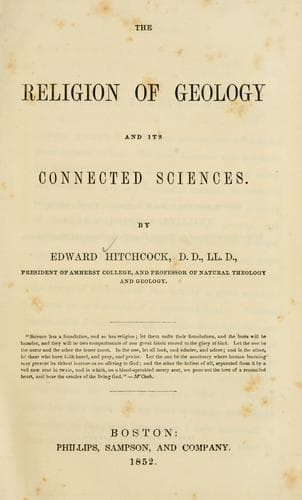
The Religion of Geology and Its Connected SciencesHitchcock, Edward
Religion
The Religion of Geology and Its Connected Sciences
Hitchcock, Edward
Bible and geology; Religion and science
If we can prove that the Deity has often so interfered with the course of
nature as to introduce new species, nay, whole races of animals and plants
upon the globe,--if, in a comparatively recent period, he has created a
moral and immortal being, endowed with all the powers of a free and an
accountable agent,--it would surely be no more wonderful if he should
communicate to that being his will by a written revelation. Indeed, the
benevolence of the Deity, as we learn it from nature, would create a
presumption that such a revelation would be given, if it appear, as we
know it does, that no sufficient knowledge is inherent in his nature to
guide him in the path of duty; since such a revelation would be no greater
miracle than to people the world, originally destitute of life, and then
to repeople it again and again, with so vast a variety of organic natures.
Philosophy has sometimes been disinclined to admit the claims of
revelation, because it implies a supernatural agency of the Deity; and,
until recently, revelation seemed to be a solitary example of special
interference on the part of Jehovah. But geology adds other examples, long
anterior to revelation--examples registered, like the laws of Sinai, on
tables of stone. And the admission of the geological evidence of special
interference with the regular sequence of nature's operations ought to
predispose the mind for listening to the appropriate proofs of a moral
communication to ignorant and erring man.
_In the second place, the subject shows us how groundless is the famous
objection to the miracles recorded in Scripture, founded on the position
that they are contrary to experience._
"It is," says Mr. Hume, "a maxim worthy of our attention, that no
testimony is sufficient to establish a miracle, unless the testimony be of
such a kind, that its falsehood would be more miraculous than the fact
which it endeavors to establish." Hence he asserts, that "the evidence of
testimony, when applied to a miracle, carries falsehood on the very face
of it, and is more properly a subject of derision than of argument," and
that "whoever believes the Christian religion is conscious of a continued
miracle in his own person, which subverts all the principles of his
understanding, and gives him a determination to believe what is most
contrary to custom and experience."
Public-domain text, read in full here on John Shaqi.
Reviews
Reviews
No reviews yet
Be the first to share your thoughts on this work.
Elsewhere in the archive
Join the Discussion
Join the discussion
Sign in to leave a comment or review.
Sign InorCreate an account