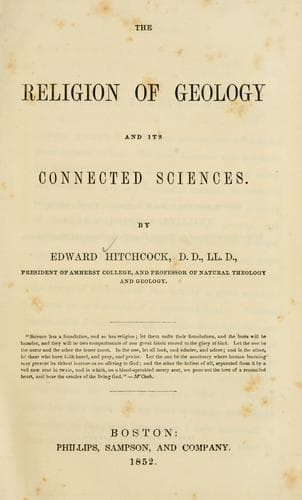
The Religion of Geology and Its Connected SciencesHitchcock, Edward
Religion
The Religion of Geology and Its Connected Sciences
Hitchcock, Edward
Bible and geology; Religion and science
In many cases, the lateral streams of influence that flow in and bring
unexpected relief to the pious man, and unexpected punishment to the
wicked, or a marked answer to prayer, seem to the individuals little short
of miraculous. Yet, after all, they can see no violation of the natural
order of cause and effect. But the wonder is, how the modifying influence
should come in just at the right moment. It may, indeed, have received a
commission to do this very thing from the immediate impulse of Jehovah;
yet, being unperceived by us, it is no miracle. Or the whole plan may have
been so arranged at the beginning that its development will meet every
case of special providence exactly. Which of these views may be most
accordant with truth, may admit of discussion. Yet we think that all the
modes that have been pointed out, by which miraculous and special
providences are brought about, may be referred to one general proposition,
which we now proceed to state.
_In the fourth place, the plan of the universe in the divine mind, at the
beginning, must have embraced every case of miracles and of special
providence._
From the nature of the divine attributes we infer with certainty that
every event occurring in the universe must have entered into the original
plan of creation in the mind of God. Surely no one will deny that he must
have foreseen the operation of every law which he established, and,
consequently, every event which it would produce. But there must be some
ground for foreknowledge to rest upon; otherwise it is conjecture, not
knowledge. And what could that basis be but the divine plan?
Equally clear is it that, whatever plans existed in the mind of God, when
he brought the universe into existence, must always have been there. For
to suppose that there was a point of duration when the plan was first
conceived, would imply new knowledge in one confessedly omniscient; and
that destroys the idea of omniscience.
Public-domain text, read in full here on John Shaqi.
Reviews
Reviews
No reviews yet
Be the first to share your thoughts on this work.
Elsewhere in the archive
Join the Discussion
Join the discussion
Sign in to leave a comment or review.
Sign InorCreate an account