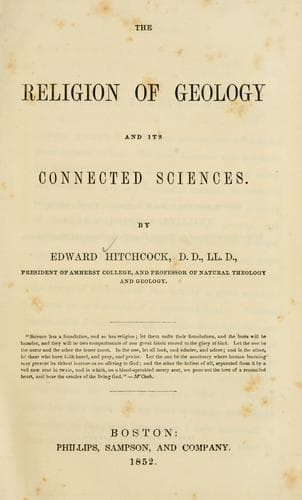
The Religion of Geology and Its Connected SciencesHitchcock, Edward
Religion
The Religion of Geology and Its Connected Sciences
Hitchcock, Edward
Bible and geology; Religion and science
When he formed it, he foresaw every possible event that would result from
its operation to the end of the world. He saw distinctly the condition of
every individual of the human family, from the beginning to the close of
life; all his dangers and trials, his sufferings and his sins; and he knew
just when and where every prayer would be offered up. Nor can it be any
more doubtful that, with infinite wisdom to guide him, and infinite power
to execute his will, God could so have arranged and constituted the laws
of nature, as to meet exactly every case that should ever occur, just in
the way he would wish to have it met. Those laws might have been so framed
and disposed that, after running on in one unvarying course for ages, a
new one might come in, or the old ones be modified, and at once produce
effects quite different, and then the first laws resume again their usual
course. And the new or modified law might be made to produce its
extraordinary or peculiar effects just at the moment when some miracle or
special providence would be needed. Thus what would be to us a special or
miraculous interposition of divine power, might be the foreseen and
foreordained result of God's original purpose. And if we can conceive how
such an effect could be produced once, we cannot doubt that infinite
wisdom and power could in like manner meet every possible case in which
what we call special and miraculous providence would be needed. With our
limited powers, we are obliged, after constructing a complicated machine,
to put it into operation before we can judge certainly of its effects; and
then, if our wishes are not met, we must alter the parts, or in some other
way meet the new cases that occur; and hence we find it difficult to
conceive how it can be otherwise with God. But he saw the operation of the
vast machine of the universe just as clearly at the beginning as at any
subsequent period. He, therefore, can do at the beginning what we can do
only after experience, viz., adapt the parts to every variety of
circumstances.
Public-domain text, read in full here on John Shaqi.
Reviews
Reviews
No reviews yet
Be the first to share your thoughts on this work.
Elsewhere in the archive
Join the Discussion
Join the discussion
Sign in to leave a comment or review.
Sign InorCreate an account