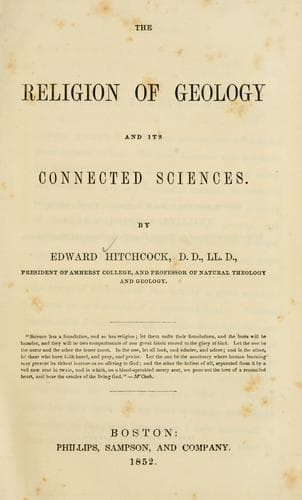
The Religion of Geology and Its Connected SciencesHitchcock, Edward
Religion
The Religion of Geology and Its Connected Sciences
Hitchcock, Edward
Bible and geology; Religion and science
The application of these statements to the doctrine of special as well as
of miraculous providence is very obvious. If human ingenuity can construct
a machine which shall exhibit the introduction of new laws, after the old
ones had been established by an induction of a hundred million of
examples, and these new ones be succeeded by others, how much easier for
the infinite God to construct the vast and more complicated machine of the
universe, so that new laws, or modifications of the old ones, shall be
introduced at various periods of its history, to meet every exigency! How
easy for him so to adjust this machine at the beginning, that the new laws
and new modes of action should be introduced, precisely at those points
where a special providence would be desirable, to reward the virtuous and
to punish the wicked, and then the old law again assume its dominion! And
how easily, in this way, could the case of every individual be met, from
the beginning to the end of the world! I mean, how easy would this work be
to infinite wisdom and power!
But if all events, miraculous as well as common, may depend upon unbending
law, how does such a view differ from the one I am now opposing, viz.,
that the constancy of nature's laws precludes the idea of any special
interference on the part of God, in human affairs? The main point of
difference, I reply, is, that the advocates of the latter view will not
admit any such thing at the present day as special interference, on the
part of the Deity, with nature. They admit only uniform and ordinary laws,
which they suppose are never interrupted. This I deny; and endeavor to
show, not only that the contrary may be a fact, but that God purposed it
originally, and determined the laws by which it might be accomplished. The
fact that he did this beforehand, even from eternity, no more precludes
his agency, than the special interference of a father to help his child
through a dangerous pass is disproved, because he foresaw the danger and
provided the means of defence even before the child was born. If the
father was actually with the child, as he went through the danger, and
held out to him the requisite help, what difference could it make, though
the father purposed to do so a long time previously? And if we admit that
God's efficiency alone gives power to the ordinary laws of nature, we
shall admit that in every special law he is as really present with his
energy, as a father who should lead his child by the hand through the
dangerous path. So that, practically at least, the difference between
these two views of the subject is very great; the one removing God far
away, and putting law in his place; and the other bringing him near, and
making him the actual and constant agent in every event. The one view is
practical atheism, although often adopted by religious men; the other is
practical Christianity.
Public-domain text, read in full here on John Shaqi.
Reviews
Reviews
No reviews yet
Be the first to share your thoughts on this work.
Elsewhere in the archive
Join the Discussion
Join the discussion
Sign in to leave a comment or review.
Sign InorCreate an account