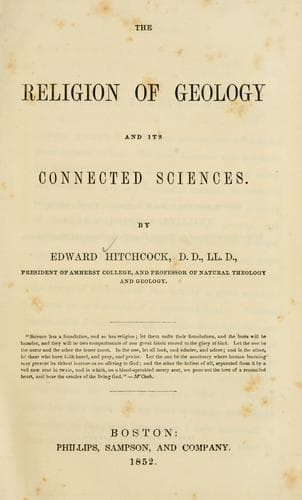
The Religion of Geology and Its Connected SciencesHitchcock, Edward
Religion
The Religion of Geology and Its Connected Sciences
Hitchcock, Edward
Bible and geology; Religion and science
The sad influence of a perversion and misunderstanding of the doctrine of
nature's constancy upon the youthful mind is well exhibited by a late able
writer. "Early trained to it under the domestic roof," says M'Cosh, "the
person regularly engaged in prayer during childhood and opening manhood.
But as he became introduced to general society, and began to feel his
independence of the guardians of his youth, he was tempted to look upon
the father's commands, in this respect, as proceeding from sourness and
sternness, and the mother's advice as originating in an amiable weakness
and timidity. He is now careless in the performance of acts which in time
past had been punctually attended to. How short, how hurried, how cold are
the prayers which he now utters! Then there come to be mornings on which
he is snatched away to some very important or enticing work without
engaging in his customary devotions. There are evenings, too, following
days of mad excitement or sinful pleasure, in which he feels utterly
indisposed to go into the presence of God, and to be left alone with him.
He feels that there is an utter incongruity between the ball-room, or the
theatre, which he has just left, and the throne of grace, to which he
should now go. What can he say to God, when he would pray to him? Confess
his sins? No; he does not at present feel the act to be sinful. Thank God
for giving him access to such follies? He has his doubts whether God
approves of all that has been done. But he may ask God's blessing? No; he
is scarcely disposed to acknowledge that he needs a blessing, or he doubts
whether the blessing would be given. The practical conclusion to which he
comes is, that it may be as consistent in him to betake himself to sleep
without offering to God what he feels would only be a mockery. What is he
to do the following morning? It is a critical time. Confess his error? No;
cherishing as he does the recollection of the gay scene in which he
mingled, and with the taste and relish of it yet upon his palate, he is
not prepared to acknowledge his folly. Morning and evening now go and
return, and bring new gifts from God, and new manifestations of his
goodness; but no acknowledgment of the divine bounty on the part of him
who is yet ever receiving it. No doubt there are times when he is prompted
to prayer by powerful feelings, called up by outward trials or inward
convictions; but ever when the storms of human life would drive him to the
shore, there is a tide beating him back. His course continues to be a very
vacillating one--now seeming to approach to God, and anon driven farther
from him, till he obtains from books, or from lectures, a smattering of
half-understood science. He now learns that all things are governed by
laws, regular and fixed, over which the breath of prayer can exert as
little influence, as they move on in their allotted course, as the passing
breeze of the earth over the sun in his circuit. False philosophy has now
Public-domain text, read in full here on John Shaqi.
Reviews
Reviews
No reviews yet
Be the first to share your thoughts on this work.
Elsewhere in the archive
Join the Discussion
Join the discussion
Sign in to leave a comment or review.
Sign InorCreate an account