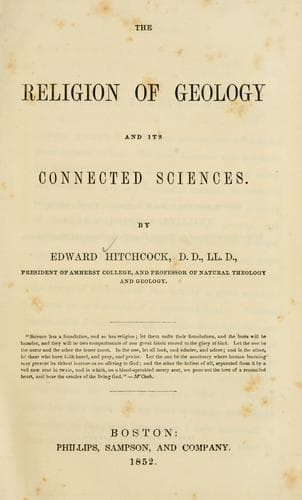
The Religion of Geology and Its Connected SciencesHitchcock, Edward
Religion
The Religion of Geology and Its Connected Sciences
Hitchcock, Edward
Bible and geology; Religion and science
It is, indeed, an instructive fact, that a science which has been thought
so full of danger to Christianity should thus early be found vindicating
some of the most peculiar and long-contested doctrines of revelation. And
yet it ought not to surprise us, for geology is as really the work of God
as revelation. And though, when ill understood and perverted, she may have
seemed recreant to her celestial origin, yet the more fully her
proportions are developed, and her features brought into daylight, the
more clearly do we recognize her alliance to every thing pure and noble in
the universe. "And surely," says a late writer, "it must be gratifying
thus to see a science, formerly classed, and not perhaps unjustly, amongst
the most pernicious to faith, once more become her handmaid; to see her
now, after so many years of wandering from theory to theory, or rather
from vision to vision, return once more to the home where she was born,
and to the altar at which she made her first simple offerings; no longer,
as she first went forth, a wilful, dreamy, empty-handed child, but with a
matronly dignity, and a priest-like step, and a bosom full of well-earned
gifts, to pile upon its sacred hearth. For it was religion which gave
geology birth, and to the sanctuary she hath once more
returned."--_Wiseman's Lectures on Science and Revealed Religion_, p. 192,
Am. ed.
LECTURE XI.
THE FUTURE CONDITION AND DESTINY OF THE EARTH.
Man has a stronger desire to penetrate the future than the past. And yet
the details of most future events are wisely concealed from him. There are
two, and only two, sources of evidence from which he can obtain some
glimpses of what will be hereafter. The one is revelation, the other
analogy. So far as God has thought proper to reveal the future, our
information is precise and certain. But it does not embrace a multitude of
events about which we have strong curiosity. By analogy is meant a
prediction of the future from the past. On the principle that nature is
constant, we infer what will be from what has been. If, however, new laws
are hereafter to come into operation, or if present agencies will then
operate very differently from what they now do, it is obvious that analogy
can be only an imperfect guide. Still, in respect to many important
events, its conclusions are infallible. Judging, for instance, from the
past, we are absolutely certain that no living thing will escape the great
law of dissolution, which, thus far, apart from the few exceptions made
known to us by revelation, has been universal.
The future changes in the condition of the earth, as they are taught us by
revelation and analogy, or, rather, by geology, will form the subject of
my present lecture. And my first object will be, to ascertain, if
possible, precisely what the Bible teaches us concerning these changes.
Public-domain text, read in full here on John Shaqi.
Reviews
Reviews
No reviews yet
Be the first to share your thoughts on this work.
Elsewhere in the archive
Join the Discussion
Join the discussion
Sign in to leave a comment or review.
Sign InorCreate an account