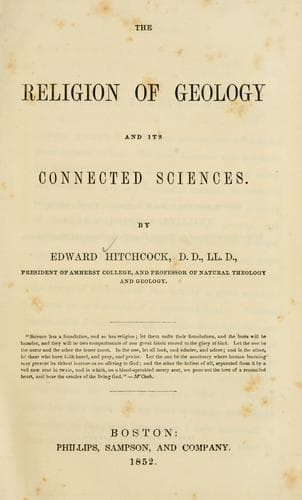
The Religion of Geology and Its Connected SciencesHitchcock, Edward
Religion
The Religion of Geology and Its Connected Sciences
Hitchcock, Edward
Bible and geology; Religion and science
_There shall come_, says he, _in the last days, scoffers, walking after
their own lusts, and saying, Where is the promise of his coming? for since
the fathers fell asleep, all things continue as they were from the
beginning of the creation. For this they willingly are ignorant of, that
by the word of God the heavens were of old, and the earth standing out of
the water and in the water; whereby the world that then was, being
overflowed with water, perished. But the heavens and the earth, which are
now, by the same word are kept in store, reserved unto fire, against the
day of judgment and perdition of ungodly men. But, beloved, be not
ignorant of this one thing, that one day is with the Lord as a thousand
years, and a thousand years as one day. The Lord is not slack concerning
his promise, as some men count slackness, but is long suffering to
us-ward, not willing that any should perish, but that all should come to
repentance. But the day of the Lord will come as a thief in the night, in
the which the heavens shall pass away with a great noise, and the elements
shall melt with fervent heat; the earth, also, and the works that are
therein, shall be burned up. Seeing, then, that all these things shall be
dissolved, what manner of persons ought ye to be in all holy conversation
and godliness? Looking for, and hasting unto the coming of the day of God,
wherein the heavens, being on fire, shall be dissolved, and the elements
shall melt with fervent heat. Nevertheless, we, according to his promise,
look for new heavens, and a new earth, wherein dwelleth righteousness._
It would require too much time, and, moreover, is not necessary to the
object I have in view, to enter into minute verbal criticism upon this
passage. I will only remark that the phrase translated _the earth and the
works that are therein_, might with equal propriety be rendered "the earth
and the works that are _thereon_;" and yet the difference of meaning
between the two modes of expression is of no great importance. Again, by
the term _heavens_, in this passage, we are evidently to understand the
atmosphere, or region immediately surrounding the earth; as in the first
chapter of Genesis, where it is said that _God called the firmament
heavens_; the plural form being used in the Hebrew, though not in the
English translation.
What, now, by a fair exegesis, is taught in this passage concerning the
destruction and renovation of the world? The following train of remark may
conduct us to the true answer to this inquiry:--
Public-domain text, read in full here on John Shaqi.
Reviews
Reviews
No reviews yet
Be the first to share your thoughts on this work.
Elsewhere in the archive
Join the Discussion
Join the discussion
Sign in to leave a comment or review.
Sign InorCreate an account