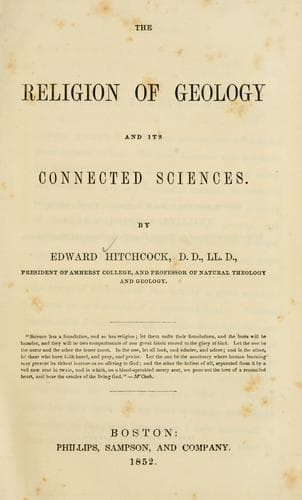
The Religion of Geology and Its Connected SciencesHitchcock, Edward
Religion
The Religion of Geology and Its Connected Sciences
Hitchcock, Edward
Bible and geology; Religion and science
"I cannot but feel astonishment," says Dr. John Pye Smith, "that any
serious and intelligent man should have his mind fettered with the common,
I might call it the vulgar, notion of a proper destruction of the earth;
and some seem to extend the notion to the whole solar system, and even the
entire material universe; applying the idea of an extinction of being, a
reducing to nothingness. This notion has, indeed, been often used to aid
impassioned description in sermons and poetry; and thus it has gained so
strong a hold upon the feelings of many pious persons, that they have made
it an article of their faith. But I confess myself unable to find any
evidence for it in nature, reason, or Scripture. We can discover nothing
like destruction in the matter of the universe as subjected to our senses.
Masses are disintegrated, forms are changed, compounds are decomposed; but
not an atom is annihilated. Neither have we the shadow of reason to assert
that mind, the seat of intelligence, ever was, or ever will be, in a
single instance, destroyed. The declaration in Scripture that _the heavens
and the earth shall flee away, and no more place be found for them_, is
undoubtedly figurative, and denotes the most momentous changes in the
scenes of the divine moral government. If it be the purpose of God that
the earth shall be subjected to a total conflagration, we perfectly well
know that the instruments of such an event lie close at hand, and wait
only the divine volition to burst out in a moment. But that would not be a
destruction; it would be a mere change of form, and, no doubt, would be
subservient to the most glorious results. _We, according to his promise,
look for new heavens and a new earth, wherein dwelleth
righteousness._"--_Lectures on Geology and Revelation_, p. 161, (4th
London edition.)
Says Dr. Griffin, one of the ablest of the American divines, "A question
here arises, whether the new heavens and new earth will be created out of
the ruins of the old; that is, whether the old will be renovated and
restored in a more glorious form, or whether the old will be annihilated,
and the new made out of nothing. The idea of the annihilation of so many
immense and glorious bodies, organized with inimitable skill, and
declarative of infinite wisdom, is gloomy and forbidding. Indeed, it is
scarcely credible that God should annihilate any of his works, much less
so many and so glorious works. It ought not to be believed without the
most decisive proof. On the other hand, it is a most animating thought
that this visible creation, which sin has marred, which the polluted
breath of men and devils has defiled, and which by sin will be reduced to
utter ruin, will be restored by our Jesus, will arise from its ruins in
tenfold splendor, and shine with more illustrious glory than before it was
defaced by sin.
Public-domain text, read in full here on John Shaqi.
Reviews
Reviews
No reviews yet
Be the first to share your thoughts on this work.
Elsewhere in the archive
Join the Discussion
Join the discussion
Sign in to leave a comment or review.
Sign InorCreate an account