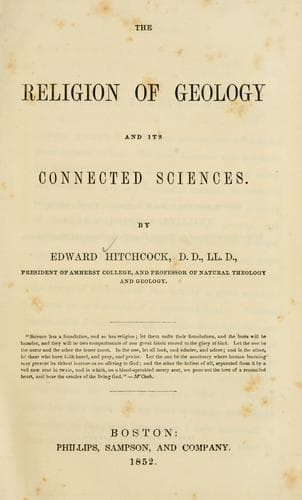
The Religion of Geology and Its Connected SciencesHitchcock, Edward
Religion
The Religion of Geology and Its Connected Sciences
Hitchcock, Edward
Bible and geology; Religion and science
Some author has remarked that, from the earliest times, there has been a
loud cry of fire. We have seen that it began with the ancient Egyptians,
and was continued by the Greeks. But in recent times it has waxed louder
and far more distinct. The ancient notions about the existence of fire
within the earth were almost entirely conjectural, but within the present
century the matter has been put to the test of experiment. Wherever, in
Europe and America, the temperature of the air, the waters, and the rocks
in deep excavations has been ascertained, it has been found higher than
the mean temperature of the climate at the surface; and the experiment has
been made in hundreds of places. It is found, too, that the heat increases
rapidly as we descend below that point in the earth's crust to which the
sun's heat extends. The mean rate of increase has been stated by the
British Association to be one degree of Fahrenheit for every forty-five
feet. At this rate, all known rocks would be melted at the depth of about
sixty miles. Shall we hence conclude that all the matter of the globe
below this thickness (or, rather, for the sake of round numbers, below one
hundred miles) is actually in a melted state? Most geologists have not
seen how such a conclusion is to be avoided. And yet this would leave only
about one eight hundredth part of the earth's diameter, and about one
fourteenth of its contents, or bulk, in a solid state. How easy, then,
should God give permission, for this vast internal fiery ocean to break
through its envelope, and so to bury the solid crust that it should all be
burnt up and melted! It is conceivable that such a result might take place
even by natural operations. And certainly it would be easy for a special
divine agency to accomplish it.
Public-domain text, read in full here on John Shaqi.
Reviews
Reviews
No reviews yet
Be the first to share your thoughts on this work.
Elsewhere in the archive
Join the Discussion
Join the discussion
Sign in to leave a comment or review.
Sign InorCreate an account