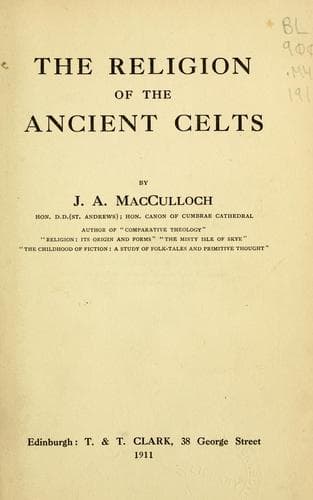
The Religion of the Ancient CeltsMacCulloch, J. A. (John Arnott)
Religion
The Religion of the Ancient Celts
MacCulloch, J. A. (John Arnott)
Celts -- Religion; Mythology, Celtic
[438] Geoffrey, vi. 17-19, vii. viii. 1, 10-12, 19. In a poem (Skene, i.
478), Myrddin is called "the man who speaks from the grave"--a
conception familiar to the Celts, who thought of the dead as living on
in the grave. See p. 340, _infra_.
[439] Rh[^y]s, _HL_, 154 f., 158-159, 194.
[440] Geoffrey, ix. 12, etc.
[441] Skene, ii. 51.
[442] Loth. i. 225; cf. p. 131, _infra_. From this description Elton
supposes Kei to have been a god of fire.
[443] _Myv. Arch._ i. 175; Loth, i. 269. Rh[^y]s, _AL_ 59, thinks Merlin
may have been Guinevere's ravisher.
[444] Holder, i. 414.
[445] Loth i. 250, 260 f., 280, ii. 215, 244.
[446] Skene, i. 363, ii. 406; _Myv. Arch._ i. 78.
[447] Hu Gadarn is mentioned in the _Triads_ as a leader of the Cymry
from the east and their teacher in ploughing. He divided them into
clans, and invented music and song. The monster _avanc_ was drawn by him
from the lake which had burst and caused the flood (see p. 231,
_infra_). Perhaps Hu is an old culture-god of some tribes, but the
_Triads_ referring to him are of late date (Loth, ii. 271, 289, 290-291,
298-299). For the ridiculous Neo-Druidic speculations based on Hu, see
Davies, _Celtic Researches_ and _Mythology and Rites of the Druids_.
Gurgiunt, son of Belinus, in Geoffrey, iii. 11, may be the French
legendary Gargantua, perhaps an old god. See the works of Sébillot and
Gaidoz on _Gargantua_.
[448] Loth, i. 270.
[449] Dio Cassius, lxii. 6.
[450] Solinus, xxii. 10. See p. 2, _supra_.
[451] Ptol. ii. 3. 2.
[452] For all these see Holder, _s.v._
CHAPTER VII.
THE CÚCHULAINN CYCLE.
The events of the Cúchulainn cycle are supposed to date from the
beginning of the Christian era--King Conchobar's death synchronising
with the crucifixion. But though some personages who are mentioned in
the Annals figure in the tales, on the whole they deal with persons who
never existed. They belong to a world of romance and myth, and embody
the ideals of Celtic paganism, modified by Christian influences and
those of classical tales and romantic sagas of other regions, mainly
Scandinavian. The present form of the tales as they exist in the _Book
of the Dun Cow_ and the _Book of Leinster_ must have been given them in
the seventh or eighth century, but they embody materials of a far older
date. At an early time the saga may have had a more or less definite
form, but new tales were being constantly added to it, and some of the
longer tales are composed of incidents which once had no connection with
each other.
Public-domain text, read in full here on John Shaqi.
Reviews
Reviews
No reviews yet
Be the first to share your thoughts on this work.
Elsewhere in the archive
Join the Discussion
Join the discussion
Sign in to leave a comment or review.
Sign InorCreate an account