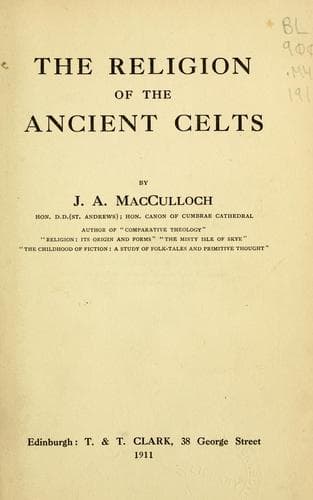
The Religion of the Ancient CeltsMacCulloch, J. A. (John Arnott)
Religion
The Religion of the Ancient Celts
MacCulloch, J. A. (John Arnott)
Celts -- Religion; Mythology, Celtic
the huge stranger to help them. He sprang from his horse and flung the
stone from its resting-place. But when he turned, his horse was gone,
and he had become a decrepit old man. Soon after he met S. Patrick and
related the tale to him.
Of most of the tales preserved in twelfth to fifteenth century MSS. it
may be said that in essence they come down to us from a remote
antiquity, like stars pulsing their clear light out of the hidden depths
of space. Many of them exist as folk-tales, often wild and weird in
form, while some folk-tales have no literary parallels. Some are
_Märchen_ with members of the Fian band as heroes, and of these there
are many European parallels. But it is not unlikely that, as in the case
of the Cúchulainn cycle, the folk versions may be truer to the original
forms of the saga than the rounded and polished literary versions.
Whatever the Fians were in origin--gods, mythic heroes, or actual
personages--it is probable that a short _Heldensage_ was formed in early
times. This slowly expanded, new tales were added, and existing
_Märchen_ formulæ were freely made use of by making their heroes the
heroes of the saga. Then came the time when many of the tales were
written down, while later they were adapted to a scheme of Irish
history, the heroes becoming warriors of a definite historic period, or
perhaps connected with such warriors. But these heroes belonged to a
timeless world, whose margins are "the shore of old romance," and it was
as if they, who were not for an age but for all time, scorned to become
the puppets of the page of history.
The earliest evidence of the attitude of the ecclesiastical world to
these heroes is found in the _Agallamh na Senorach_, or "Colloquy of the
Ancients."[515] This may have been composed in the thirteenth century,
and its author knew scores of Fionn legends. Making use of the tradition
that Caoilte and Oisin had met S. Patrick, he makes Caoilte relate many
of the tales, usually in connection with some place-name of Fian origin.
The saint and his followers are amazed at the huge stature of the Fians,
but Patrick asperges them with holy water, and hosts of demons flee from
them. At each tale which Caoilte tells, the saint says, "Success and
benediction, Caoilte. All this is to us a recreation of spirit and of
mind, were it only not a destruction of devotion and a dereliction of
prayer." But presently his guardian angel appears, and bids him not only
listen to the tales but cause them to be written down. He and his
attendant clerics now lend a willing ear to the recital and encourage
the narrator with their applause. Finally, baptism is administered to
Caoilte and his men, and by Patrick's intercessions Caoilte's relations
and Fionn himself are brought out of hell. In this work the
representatives of paganism are shown to be on terms of friendliness
with the representatives of Christianity.
Public-domain text, read in full here on John Shaqi.
Reviews
Reviews
No reviews yet
Be the first to share your thoughts on this work.
Elsewhere in the archive
Join the Discussion
Join the discussion
Sign in to leave a comment or review.
Sign InorCreate an account