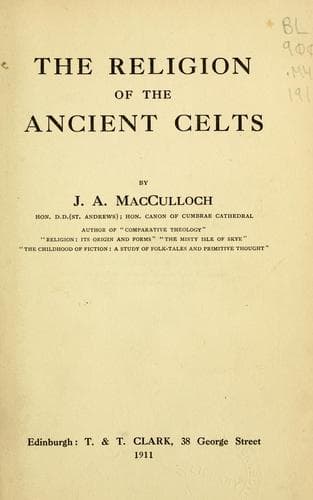
The Religion of the Ancient CeltsMacCulloch, J. A. (John Arnott)
Religion
The Religion of the Ancient Celts
MacCulloch, J. A. (John Arnott)
Celts -- Religion; Mythology, Celtic
If in early times the spirit of vegetation was feminine, her
representative would be a woman, probably slain at recurring festivals
by the female worshippers. This would explain the slaying of one of
their number at a festival by Namnite women. But when male spirits or
gods superseded goddesses, the divine priest-king would take the place
of the female representative. On the other hand, just as the goddess
became the consort of the god, a female representative would continue as
the divine bride in the ritual of the sacred marriage, the May Queen of
later folk-custom. Sporadically, too, conservatism would retain female
cults with female divine incarnations, as is seen by the presence of the
May Queen alone in certain folk-survivals, and by many Celtic rituals
from which men were excluded.[531]
FOOTNOTES:
[516] O'Grady, ii. 228.
[517] Ibid. ii. 203. Cf. Cæsar, vi. 14, "the immortal gods" of Gaul.
[518] Cf. Ch. XXIV.; O'Grady, ii. 110, 172; Nutt-Meyer, i. 42.
[519] Leahy, ii. 6.
[520] _IT_ iii. 203; _Trip. Life_, 507; _Annals of the Four Masters_,
A.D. 14; _RC_ xxii. 28, 168. Chiefs as well as kings probably influenced
fertility. A curious survival of this is found in the belief that
herrings abounded in Dunvegan Loch when MacLeod arrived at his castle
there, and in the desire of the people in Skye during the potato famine
that his fairy banner should be waved.
[521] An echo of this may underlie the words attributed to King Ailill,
"If I am slain, it will be the redemption of many" (O'Grady, ii. 416).
[522] See Frazer, _Kingship_; Cook, _Folk-Lore_, 1906, "The European
Sky-God." Mr. Cook gives ample evidence for the existence of Celtic
incarnate gods. With his main conclusions I agree, though some of his
inferences seem far-fetched. The divine king was, in his view, a
sky-god; he was more likely to have been the representative of a god or
spirit of growth or vegetation.
[523] Strabo, xii. 5. 2.
[524] Plutarch, _de Virt. Mul._ 20.
[525] Cicero, _de Div._ i. 15, ii. 36; Strabo, xii. 5. 3; Stachelin,
_Gesch. der Kleinasiat. Galater._
[526] Livy, v. 34; Dio Cass. lxii. 6.
[527] _Ancient Laws of Ireland_, i. 22; Diog. Laert. i. proem 1; see p.
301, _infra_.
[528] Pliny, xvi. 95.
[529] P. 201, _infra_.
[530] Cf. the tales of Gawain and the Green Knight with his holly bough,
and of Gawain's attempting to pluck the bough of a tree guarded by
Gramoplanz (Weston, _Legend of Sir Gawain_, 22, 86). Cf. also the tale
of Diarmaid's attacking the defender of a tree to obtain its fruit, and
the subsequent slaughter of each man who attacks the hero hidden in its
branches (_TOS_ vol. iii.). Cf. Cook, _Folk-Lore_, xvii. 441.
[531] See Chap. XVIII.
CHAPTER X.
THE CULT OF THE DEAD.
Public-domain text, read in full here on John Shaqi.
Reviews
Reviews
No reviews yet
Be the first to share your thoughts on this work.
Elsewhere in the archive
Join the Discussion
Join the discussion
Sign in to leave a comment or review.
Sign InorCreate an account