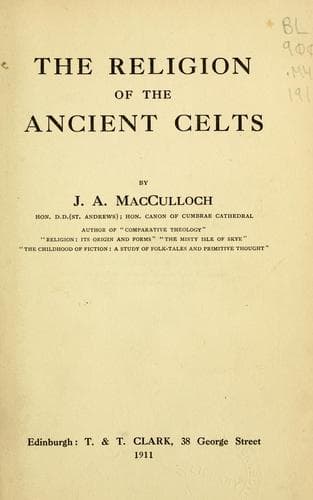
The Religion of the Ancient CeltsMacCulloch, J. A. (John Arnott)
Religion
The Religion of the Ancient Celts
MacCulloch, J. A. (John Arnott)
Celts -- Religion; Mythology, Celtic
The dead were also fed at the grave or in the house. Thus cups were
placed in the recess of a well in the churchyard of Kilranelagh by those
interring a child under five, and the ghost of the child was supposed to
supply the other spirits with water from these cups.[542] In Ireland,
after a death, food is placed out for the spirits, or, at a burial, nuts
are placed in the coffin.[543] In some parts of France, milk is poured
out on the grave, and both in Brittany and in Scotland the dead are
supposed to partake of the funeral feast.[544] These are survivals from
pagan times and correspond to the rites in use among those who still
worship ancestors. In Celtic districts a cairn or a cross is placed over
the spot where a violent or accidental death has occurred, the purpose
being to appease the ghost, and a stone is often added to the cairn by
all passers-by.[545]
Festivals were held in Ireland on the anniversaries of the death of
kings or chiefs, and these were also utilised for purposes of trade,
pleasure, or politics. They sometimes occurred on the great festivals,
e.g. Lugnasad and Samhain, and were occasionally held at the great
burial-places.[546] Thus the gathering at Taillti on Lugnasad was said
to have been founded by Lug in memory of his foster-mother, Tailtiu, and
the Leinstermen met at Carman on the same day to commemorate King
Garman, or in a variant account, a woman called Carman. She and her sons
had tried to blight the corn of the Tuatha Dé Danann, but the sons were
driven off and she died of grief, begging that a fair should always be
held in her name, and promising abundance of milk, fruit, and fish for
its observance.[547] These may be ætiological myths explaining the
origin of these festivals on the analogy of funeral festivals, but more
likely, since Lugnasad was a harvest festival, they are connected with
the custom of slaying a representative of the corn-spirit. The festival
would become a commemoration of all such victims, but when the custom
itself had ceased it would be associated with one particular personage,
the corn-goddess regarded as a mortal.
Public-domain text, read in full here on John Shaqi.
Reviews
Reviews
No reviews yet
Be the first to share your thoughts on this work.
Elsewhere in the archive
Join the Discussion
Join the discussion
Sign in to leave a comment or review.
Sign InorCreate an account