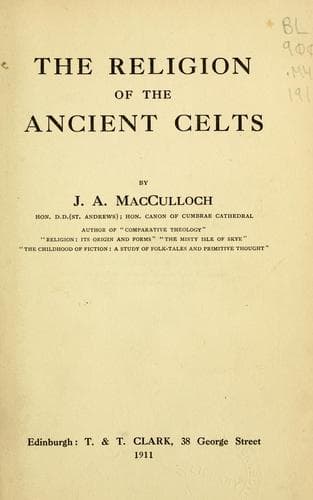
The Religion of the Ancient CeltsMacCulloch, J. A. (John Arnott)
Religion
The Religion of the Ancient Celts
MacCulloch, J. A. (John Arnott)
Celts -- Religion; Mythology, Celtic
These ideas take us back to a time when it was held that the moon was
not merely the measurer of time, but had powerful effects on the
processes of growth and decay. Artemis and Diana, moon-goddesses, had
power over all growing things, and as some Celtic goddesses were equated
with Diana, they may have been connected with the moon, more especially
as Gallo-Roman images of Diana have the head adorned with a crescent
moon. In some cases festivals of the moon remained intact, as among the
Celtiberians and other peoples to the north of them, who at the time of
full moon celebrated the festival of a nameless god, dancing all night
before the doors of their houses.[579] The nameless god may have been
the moon, worshipped at the time of her intensest light. Moonlight
dances round a great stone, with singing, on the first day of the year,
occurred in the Highlands in the eighteenth century.[580] Other
survivals of cult are seen in the practices of bowing or baring the head
at new moon, or addressing it with words of adoration or supplication.
In Ireland, Camden found the custom at new moon of saying the Lord's
Prayer with the addition of the words, "Leave us whole and sound as Thou
hast found us." Similar customs exist in Brittany, where girls pray to
the moon to grant them dreams of their future husbands.[581] Like other
races, the Celts thought that eclipses were caused by a monster
attacking the moon, while it could be driven off with cries and shouts.
In 218 B.C. the Celtic allies of Attalus were frightened by an eclipse,
and much later Christian legislation forbade the people to assemble at
an eclipse and shout, _Vince, Luna!_[582] Such a practice was observed
in Ireland in the seventeenth century. At an earlier time, Irish poets
addressed sun and moon as divinities, and they were represented on
altars even in Christian times.[583]
Public-domain text, read in full here on John Shaqi.
Reviews
Reviews
No reviews yet
Be the first to share your thoughts on this work.
Elsewhere in the archive
Join the Discussion
Join the discussion
Sign in to leave a comment or review.
Sign InorCreate an account