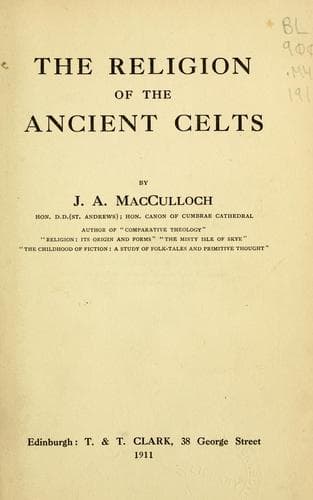
The Religion of the Ancient CeltsMacCulloch, J. A. (John Arnott)
Religion
The Religion of the Ancient Celts
MacCulloch, J. A. (John Arnott)
Celts -- Religion; Mythology, Celtic
[574] Cæsar, vi. 18; Pliny xxii. 14. Pliny speaks of culling mistletoe
on the sixth day of the moon, which is to them the beginning of months
and years (_sexta luna, quae principia_, etc.). This seems to make the
sixth, not the first, day of the moon that from which the calculation
was made. But the meaning is that mistletoe was culled on the sixth day
of the moon, and that the moon was that by which months and years were
measured. _Luna_, not _sexta luna_, is in apposition with _quae_. Traces
of the method of counting by nights or by the moon survive locally in
France, and the usage is frequent in Irish and Welsh literature. See my
article "Calendar" (Celtic) in Hastings' _Encyclop. of Religion and
Ethics_, iii. 78 f.
[575] Delocke, "La Procession dite La Lunade," _RC_ ix. 425.
[576] Monnier, 174, 222; Fitzgerald, _RC_ iv. 189.
[577] Frazer, _Golden Bough_{2}, ii. 154 f.
[578] Pliny, xvi. 45; Johnson, _Journey_, 183; Ramsay, _Scotland in the
Eighteenth Century_, ii. 449; Sébillot, i. 41 f.; MacCulloch, _Misty
Isle of Skye_, 236. In Brittany it is thought that girls may conceive by
the moon's power (_RC_ iii. 452).
[579] Strabo, iii. 4. 16.
[580] Brand, _s.v._ "New Year's Day."
[581] Chambers, _Popular Rhymes_, 35; Sébillot, i. 46, 57 f.
[582] Polybius, v. 78; _Vita S. Eligii_, ii. 15.
[583] Osborne, _Advice to his Son_ (1656), 79; _RC_ xx. 419, 428.
[584] Aristotle, _Nic. Eth._ iii. 77; _Eud. Eth._ iii. 1. 25; Stobæus,
vii. 40; Ælian, xii. 22; Jullian, 54; D'Arbois, vi. 218.
[585] Sébillot, i. 119. The custom of throwing something at a "fairy
eddy," i.e. a dust storm, is well known on Celtic ground and elsewhere.
[586] _Folk-Lore,_ iv. 488; Curtin, _HTI_ 324; Campbell, _The Fians_,
158. Fian warriors attacked the sea when told it was laughing at them.
[587] _Mélusine_, ii. 200.
[588] Sébillot, ii. 170.
[589] Meyer, _Cath. Finntraga_, 40.
[590] _RC_ xvi. 9; _LB_ 32_b_, 55.
[591] Meyer, _op. cit._ 55; Skene, i. 282, 288, 543; Rh[^y]s, _HL_ 387.
[592] Meyer, 51; Joyce, _PN_ i. 195, ii. 257; _RC_ xv. 438.
[593] See p. 55, _supra_; _IT_ i. 838, iii. 207; _RC_ ii. 201, ix. 118.
[594] Holder, _s.v._ "Vintius."
[595] Agobard, i. 146.
[596] See Stokes, _RC_ vi. 267.
CHAPTER XII.
RIVER AND WELL WORSHIP.
Among the Celts the testimony of contemporary witnesses, inscriptions,
votive offerings, and survivals, shows the importance of the cult of
waters and of water divinities. Mr. Gomme argues that Celtic
water-worship was derived from the pre-Celtic aborigines,[597] but if
so, the Celts must have had a peculiar aptitude for it, since they were
so enthusiastic in its observance. What probably happened was that the
Celts, already worshippers of the waters, freely adopted local cults of
water wherever they came. Some rivers or river-goddesses in Celtic
regions seem to posses pre-Celtic names.[598]
Public-domain text, read in full here on John Shaqi.
Reviews
Reviews
No reviews yet
Be the first to share your thoughts on this work.
Elsewhere in the archive
Join the Discussion
Join the discussion
Sign in to leave a comment or review.
Sign InorCreate an account