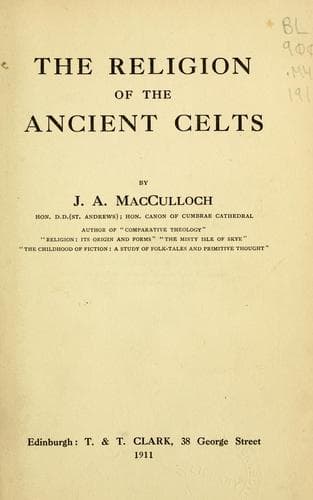
The Religion of the Ancient CeltsMacCulloch, J. A. (John Arnott)
Religion
The Religion of the Ancient Celts
MacCulloch, J. A. (John Arnott)
Celts -- Religion; Mythology, Celtic
In spite of twenty centuries of Christianity and the anathemas of saints
and councils, the old pagan practices at healing wells have survived--a
striking instance of human conservatism. S. Patrick found the pagans of
his day worshipping a well called _Slán_, "health-giving," and offering
sacrifices to it,[643] and the Irish peasant to-day has no doubt that
there is something divine about his holy wells. The Celts brought the
belief in the divinity of springs and wells with them, but would
naturally adopt local cults wherever they found them. Afterwards the
Church placed the old pagan wells under the protection of saints, but
part of the ritual often remained unchanged. Hence many wells have been
venerated for ages by different races and through changes in religion
and polity. Thus at the thermal springs of Vicarello offerings have been
found which show that their cult has continued from the Stone Age,
through the Bronze Age, to the days of Roman civilisation, and so into
modern times; nor is this a solitary instance.[644] But it serves to
show that all races, high and low, preserve the great outlines of
primitive nature religion unchanged. In all probability the ritual of
the healing wells has also remained in great part unaltered, and
wherever it is found it follows the same general type. The patient
perambulated the well three times _deiseil_ or sun-wise, taking care not
to utter a word. Then he knelt at the well and prayed to the divinity
for his healing. In modern times the saint, but occasionally the well
itself, is prayed to.[645] Then he drank of the waters, bathed in them,
or laved his limbs or sores, probably attended by the priestess of the
well. Having paid her dues, he made an offering to the divinity of the
well, and affixed the bandage or part of his clothing to the well or a
tree near by, that through it he might be in continuous _rapport_ with
the healing influences. Ritual formulæ probably accompanied these acts,
but otherwise no word was spoken, and the patient must not look back on
leaving the well. Special times, Beltane, Midsummer, or August 1st, were
favourable for such visits,[646] and where a patient was too ill to
present himself at the well, another might perform the ritual for
him.[647]
Public-domain text, read in full here on John Shaqi.
Reviews
Reviews
No reviews yet
Be the first to share your thoughts on this work.
Elsewhere in the archive
Join the Discussion
Join the discussion
Sign in to leave a comment or review.
Sign InorCreate an account