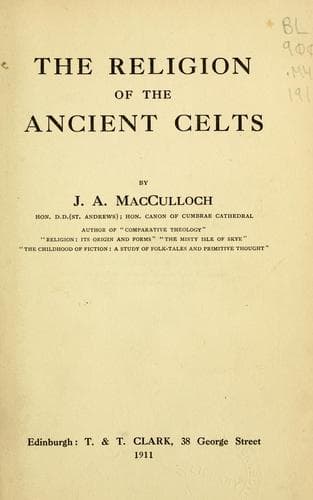
The Religion of the Ancient CeltsMacCulloch, J. A. (John Arnott)
Religion
The Religion of the Ancient Celts
MacCulloch, J. A. (John Arnott)
Celts -- Religion; Mythology, Celtic
The presence of a bull with three cranes (_Tarvos Trigaranos_) on the
Paris altar, along with the gods Esus, Juppiter, and Vulcan, suggests
that it was a divine animal, or the subject of a divine myth. As has
been seen, this bull may be the bull of the _Táin bó Cuailgne_. Both it
and its opponent were reincarnations of the swine-herds of two gods. In
the Irish sagas reincarnation is only attributed to gods or heroes, and
this may point to the divinity of the bulls. We have seen that this and
another altar may depict some myth in which the bull was the incarnation
of a tree or vegetation spirit. The divine nature of the bull is
attested by its presence on Gaulish coins as a religious symbol, and by
images of the animal with three horns--an obvious symbol of
divinity.[696] On such an image in bronze the Cimbri, Celticised
Germans, swore. The images are pre-Roman, since they are found at
Hallstadt and La Tène. Personal names like Donnotaurus (the equivalent
of the _Donn Taruos_ of the _Táin_) or Deiotaros ("divine bull"), show
that men were called after the divine animal.[697] Similarly many
place-names in which the word _taruos_ occurs, in Northern Italy, the
Pyrenees, Scotland, Ireland, and elsewhere, suggest that the places
bearing these names were sites of a bull cult or that some myth, like
that elaborated in the _Táin_, had been there localised.[698] But, as
possibly in the case of Cúchulainn and the bull, the animal tended to
become the symbol of a god, a tendency perhaps aided by the spread of
Mithraism with its symbolic bull. A god Medros leaning on a bull is
represented at Haguenau, possibly a form of Mider or of Meduris, a
surname of Toutatis, unless Medros is simply Mithras.[699] Echoes of the
cult of the bull or cow are heard in Irish tales of these animals
brought from the _síd_, or of magic bulls or of cows which produced
enormous supplies of milk, or in saintly legends of oxen leading a saint
to the site of his future church.[700] These legends are also told of
the swine,[701] and they perhaps arose when a Christian church took the
place of the site of a local animal cult, legend fusing the old and the
new cult by making the once divine animal point out the site of the
church. A late relic of a bull cult may be found in the carnival
procession of the _Boeuf Gras_ at Paris.
Public-domain text, read in full here on John Shaqi.
Reviews
Reviews
No reviews yet
Be the first to share your thoughts on this work.
Elsewhere in the archive
Join the Discussion
Join the discussion
Sign in to leave a comment or review.
Sign InorCreate an account