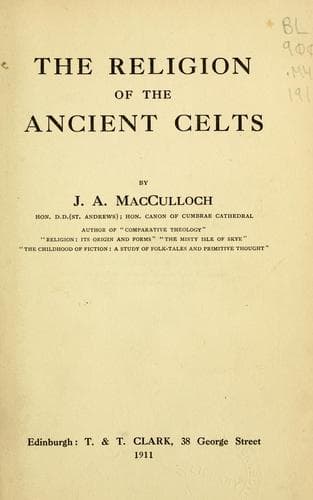
The Religion of the Ancient CeltsMacCulloch, J. A. (John Arnott)
Religion
The Religion of the Ancient Celts
MacCulloch, J. A. (John Arnott)
Celts -- Religion; Mythology, Celtic
Danube area, and these may depict myths telling how the clan totem
animal led the clan to its present territory.[735] Such myths may
survive in legends relating how an animal led a saint to the site of his
church.[736] Celtic warriors wore helmets with horns, and Irish story
speaks of men with cat, dog, or goat heads.[737] These may have been men
wearing a head-gear formed of the skin or head of the clan totem, hence
remembered at a later time as monstrous beings, while the horned helmets
would be related to the same custom. Solinus describes the Britons as
wearing animal skins before going into battle.[738] Were these skins of
totem animals under whose protection they thus placed themselves? The
"forms of beasts, birds, and fishes" which the Cruithne or Picts
tattooed on their bodies may have been totem marks, while the painting
of their bodies with woad among the southern Britons may have been of
the same character, though Cæsar's words hardly denote this. Certain
marks on faces figured on Gaulish coins seem to be tattoo marks.[739]
It is not impossible that an early wolf-totem may have been associated,
because of the animal's nocturnal wanderings in forests, with the
underworld whence, according to Celtic belief, men sprang and whither
they returned, and whence all vegetation came forth. The Gallo-Roman
Silvanus, probably an underworld god, wears a wolf-skin, and may thus be
a wolf-god. There were various types of underworld gods, and this
wolf-type--perhaps a local wolf-totem ancestor assimilated to a local
"Dispater"--may have been the god of a clan who imposed its mythic wolf
origin on other clans. Some Celtic bronzes show a wolf swallowing a man
who offers no resistance, probably because he is dead. The wolf is much
bigger than the man, and hence may be a god.[740] These bronzes would
thus represent a belief setting forth the return of men to their totem
ancestor after death, or to the underworld god connected with the totem
ancestor, by saying that he devoured the dead, like certain Polynesian
divinities and the Greek Eurynomos.
Public-domain text, read in full here on John Shaqi.
Reviews
Reviews
No reviews yet
Be the first to share your thoughts on this work.
Elsewhere in the archive
Join the Discussion
Join the discussion
Sign in to leave a comment or review.
Sign InorCreate an account