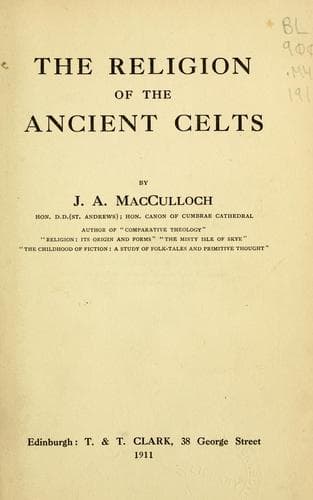
The Religion of the Ancient CeltsMacCulloch, J. A. (John Arnott)
Religion
The Religion of the Ancient Celts
MacCulloch, J. A. (John Arnott)
Celts -- Religion; Mythology, Celtic
Human sacrifice in Gaul was put down by the Romans, who were amazed at
its extent, Suetonius summing up the whole religion in a
phrase--_druidarum religionem diræ immanitatis_.[803] By the year 40
A.D. it had ceased, though victims were offered symbolically, the Druids
pretending to strike them and drawing a little blood from them.[804]
Only the pressure of a higher civilisation forced the so-called
philosophic Druids to abandon their revolting customs. Among the Celts
of Britain human sacrifice still prevailed in 77 A.D.[805] Dio Cassius
describes the refinements of cruelty practised on female victims
(prisoners of war) in honour of the goddess Andrasta--their breasts cut
off and placed over their mouths, and a stake driven through their
bodies, which were then hung in the sacred grove.[806] Tacitus speaks of
the altars in Mona (Anglesey) laved with human blood. As to the Irish
Celts, patriotic writers have refused to believe them guilty of such
practices,[807] but there is no _a priori_ reason which need set them
apart from other races on the same level of civilisation in this custom.
The Irish texts no doubt exaggerate the number of the victims, but they
certainly attest the existence of the practice. From the _Dindsenchas_,
which describes many archaic usages, we learn that "the firstlings of
every issue and the chief scions of every clan" were offered to Cromm
Cruaich--a sacrifice of the first-born,--and that at one festival the
prostrations of the worshippers were so violent that three-fourths of
them perished, not improbably an exaggerated memory of orgiastic
rites.[808] Dr. Joyce thinks that these notices are as incredible as the
mythic tales in the _Dindsenchas_. Yet the tales were doubtless quite
credible to the pagan Irish, and the ritual notices are certainly
founded on fact. Dr. Joyce admits the existence of foundation sacrifices
in Ireland, and it is difficult to understand why human victims may not
have been offered on other occasions also.
The purpose of the sacrifice, namely, fertility, is indicated in the
poetical version of the cult of Cromm--
"Milk and corn
They would ask from him speedily,
In return for one-third of their healthy issue."[809]
Public-domain text, read in full here on John Shaqi.
Reviews
Reviews
No reviews yet
Be the first to share your thoughts on this work.
Elsewhere in the archive
Join the Discussion
Join the discussion
Sign in to leave a comment or review.
Sign InorCreate an account