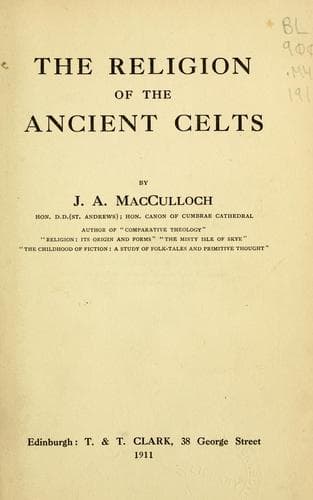
The Religion of the Ancient CeltsMacCulloch, J. A. (John Arnott)
Religion
The Religion of the Ancient Celts
MacCulloch, J. A. (John Arnott)
Celts -- Religion; Mythology, Celtic
Of all these varieties of human sacrifice, those offered for fertility,
probably at Beltane or Midsummer, were the most important. Their
propitiatory nature is of later origin, and their real intention was to
strengthen the divinity by whom the processes of growth were directed.
Still earlier, one victim represented the divinity, slain that his life
might be revived in vigour. The earth was sprinkled with his blood and
fed with his flesh in order to fertilise it, and possibly the
worshippers partook sacramentally of the flesh. Propitiatory holocausts
of human victims had taken the place of the slain representative of a
god, but their value in promoting fertility was not forgotten. The
sacramental aspect of the rite is perhaps to be found in Pliny's words
regarding "the slaying of a human being as a most religious act and
eating the flesh as a wholesome remedy" among the Britons.[820] This may
merely refer to "medicinal cannibalism," such as still survives in
Italy, but the passage rather suggests sacramental cannibalism, the
eating of part of a divine victim, such as existed in Mexico and
elsewhere. Other acts of cannibalism are referred to by classical
writers. Diodorus says the Irish ate their enemies, and Pausanias
describes the eating the flesh and drinking the blood of children among
the Galatian Celts. Drinking out of a skull the blood of slain
(sacrificial) enemies is mentioned by Ammianus and Livy, and Solinus
describes the Irish custom of bathing the face in the blood of the slain
and drinking it.[821] In some of these cases the intention may simply
have been to obtain the dead enemy's strength, but where a sacrificial
victim was concerned, the intention probably went further than this. The
blood of dead relatives was also drunk in order to obtain their virtues,
or to be brought into closer _rapport_ with them.[822] This is analogous
to the custom of blood brotherhood, which also existed among the Celts
and continued as a survival in the Western Isles until a late date.[823]
One group of Celtic human sacrifices was thus connected with primitive
agricultural ritual, but the warlike energies of the Celts extended the
practice. Victims were easily obtained, and offered to the gods of war.
Yet even these sacrifices preserved some trace of the older rite, in
which the victim represented a divinity or spirit.
Public-domain text, read in full here on John Shaqi.
Reviews
Reviews
No reviews yet
Be the first to share your thoughts on this work.
Elsewhere in the archive
Join the Discussion
Join the discussion
Sign in to leave a comment or review.
Sign InorCreate an account