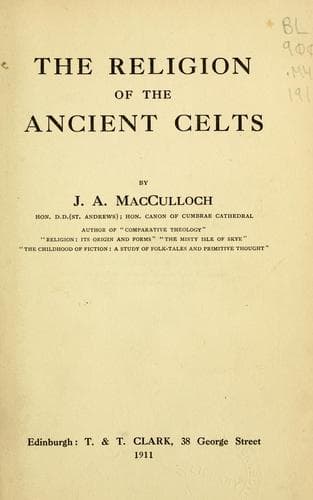
The Religion of the Ancient CeltsMacCulloch, J. A. (John Arnott)
Religion
The Religion of the Ancient Celts
MacCulloch, J. A. (John Arnott)
Celts -- Religion; Mythology, Celtic
disinterred it,[833] the story being based on the belief that heads or
bodies of great warriors still had a powerful influence.[834] The
representation of the head of a god, like his whole image, would be
thought to possess the same preservative power.
A possible survival of the sacrifice of the aged may be found in a
Breton custom of applying a heavy club to the head of old persons to
lighten their death agonies, the clubs having been formerly used to kill
them. They are kept in chapels, and are regarded with awe.[835]
Animal victims were also frequently offered. The Galatian Celts made a
yearly sacrifice to their Artemis of a sheep, goat, or calf, purchased
with money laid by for each animal caught in the chase. Their dogs were
feasted and crowned with flowers.[836] Further details of this ritual
are unfortunately lacking. Animals captured in war were sacrificed to
the war-gods by the Gauls, or to a river-god, as when the horses of the
defeated host were thrown into the Rhine by the Gaulish conquerors of
Mallius.[837] We have seen that the white oxen sacrificed at the
mistletoe ritual may once have been representatives of the
vegetation-spirit, which also animated the oak and the mistletoe. Among
the insular Celts animal sacrifices are scarcely mentioned in the texts,
probably through suppression by later scribes, but the lives of Irish
saints contain a few notices of the custom, e.g. that of S. Patrick,
which describes the gathering of princes, chiefs, and Druids at Tara to
sacrifice victims to idols.[838] In Ireland the peasantry still kill a
sheep or heifer for S. Martin on his festival, and ill-luck is thought
to follow the non-observance of the rite.[839] Similar sacrifices on
saints' days in Scotland and Wales occurred in Christian times.[840] An
excellent instance is that of the sacrifice of bulls at Gairloch for the
cure of lunatics on S. Maelrubha's day (August 25th). Libations of milk
were also poured out on the hills, ruined chapels were perambulated,
wells and stones worshipped, and divination practised. These rites,
occurring in the seventeenth century, were condemned by the Presbytery
of Dingwall, but with little effect, and some of them still
survive.[841] In all these cases the saint has succeeded to the ritual
of an earlier god. Mr. Cook surmises that S. Maelrubha was the successor
of a divine king connected with an oak and sacred well, the god or
spirit of which was incarnate in him. These divine kings may at one time
have been slain, or a bull, similarly incarnating the god or spirit, may
have been killed as a surrogate. This slaying was at a later time
regarded as a sacrifice and connected with the cure of madness.[842] The
rite would thus be on a parallel with the slaying of the oxen at the
mistletoe gathering, as already interpreted. Eilean Maree (Maelrubha),
where the tree and well still exist, was once known as Eilean mo righ
("the island of my king"), or Eilean a Mhor Righ ("of the great king"),
Public-domain text, read in full here on John Shaqi.
Reviews
Reviews
No reviews yet
Be the first to share your thoughts on this work.
Elsewhere in the archive
Join the Discussion
Join the discussion
Sign in to leave a comment or review.
Sign InorCreate an account