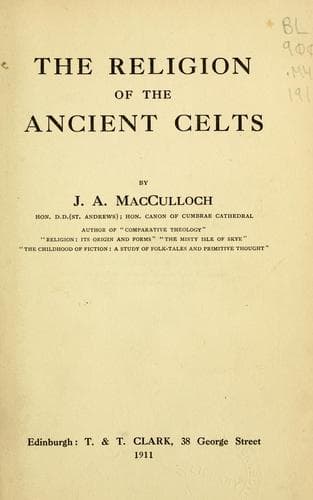
The Religion of the Ancient CeltsMacCulloch, J. A. (John Arnott)
Religion
The Religion of the Ancient Celts
MacCulloch, J. A. (John Arnott)
Celts -- Religion; Mythology, Celtic
Samhain,[892] beginning the Celtic year, was an important social and
religious occasion. The powers of blight were beginning their
ascendancy, yet the future triumph of the powers of growth was not
forgotten. Probably Samhain had gathered up into itself other feasts
occurring earlier or later. Thus it bears traces of being a harvest
festival, the ritual of the earlier harvest feast being transferred to
the winter feast, as the Celts found themselves in lands where harvest
is not gathered before late autumn. The harvest rites may, however, have
been associated with threshing rather than ingathering. Samhain also
contains in its ritual some of the old pastoral cults, while as a New
Year feast its ritual is in great part that of all festivals of
beginnings.
New fire was brought into each house at Samhain from the sacred
bonfire,[893] itself probably kindled from the need-fire by the friction
of pieces of wood. This preserved its purity, the purity necessary to a
festival of beginnings.[894] The putting away of the old fires was
probably connected with various rites for the expulsion of evils, which
usually occur among many peoples at the New Year festival. By that
process of dislocation which scattered the Samhain ritual over a wider
period and gave some of it to Christmas, the kindling of the Yule log
may have been originally connected with this festival.
Divination and forecasting the fate of the inquirer for the coming year
also took place. Sometimes these were connected with the bonfire, stones
placed in it showing by their appearance the fortune or misfortune
awaiting their owners.[895] Others, like those described by Burns in his
"Hallowe'en," were unconnected with the bonfire and were of an erotic
nature.[896]
The slaughter of animals for winter consumption which took place at
Samhain, or, as now, at Martinmas, though connected with economic
reasons, had a distinctly religious aspect, as it had among the Teutons.
In recent times in Ireland one of the animals was offered to S. Martin,
who may have taken the place of a god, and ill-luck followed the
non-observance of the custom.[897] The slaughter was followed by general
feasting. This later slaughter may be traced back to the pastoral stage,
in which the animals were regarded as divine, and one was slain annually
and eaten sacramentally. Or, if the slaughter was more general, the
animals would be propitiated. But when the animals ceased to be
worshipped, the slaughter would certainly be more general, though still
preserving traces of its original character. The pastoral sacrament may
also have been connected with the slaying and eating of an animal
representing the corn-spirit at harvest time. In one legend S. Martin is
associated with the animal slain at Martinmas, and is said to have been
cut up and eaten in the form of an ox,[898] as if a former divine animal
had become an anthropomorphic divinity, the latter being merged in the
personality of a Christian saint.
Public-domain text, read in full here on John Shaqi.
Reviews
Reviews
No reviews yet
Be the first to share your thoughts on this work.
Elsewhere in the archive
Join the Discussion
Join the discussion
Sign in to leave a comment or review.
Sign InorCreate an account