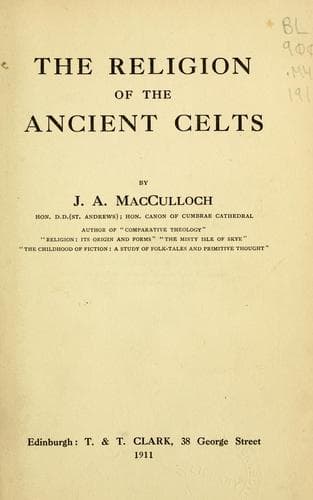
The Religion of the Ancient CeltsMacCulloch, J. A. (John Arnott)
Religion
The Religion of the Ancient Celts
MacCulloch, J. A. (John Arnott)
Celts -- Religion; Mythology, Celtic
stone, and having besought them to desist, he carved a cross upon
it.[973] Several _menhirion_ in France are now similarly
ornamented.[974]
The number of existing Gallo-Roman images shows that the Celts had not
adopted a custom which was foreign to them, and they must have already
possessed rude native images. The disappearance of these would be
explained if they were made of perishable material. Wooden images of the
_Matres_ have been occasionally found, and these may be pre-Roman. Some
of the images of the three-headed and crouching gods show no sign of
Roman influences in their modelling, and they may have been copied from
earlier images of wood. We also find divine figures on pre-Roman
coins.[975] Certain passages in classical writings point to the
existence of native images. A statue of a goddess existed in a temple at
Marseilles, according to Justin, and the Galatian Celts had images of
the native Juppiter and Artemis, while the conquering Celts who entered
Rome bowed to the seated senators as to statues of the gods.[976] The
Gauls placed rich ornaments on the images of the gods, and presumably
these were native "idols."
"Idols" are frequently mentioned in Irish texts, and there is no doubt
that these mean images.[977] Cormac mac Art refused to worship "idols,"
and was punished by the Druids.[978] The idols of Cromm Cruaich and his
satellites, referred to in the _Dindsenchas_, were carved to represent
the human form; the chief one was of gold, the others of stone. These
were miraculously overthrown by S. Patrick; but in the account of the
miracle the chief idol was of stone adorned with gold and silver, the
others, numbering twelve, were ornamented with bronze.[979] They stood
in Mag Slecht, and similar sacred places with groups of images evidently
existed elsewhere, e.g. at Rath Archaill, "where the Druid's altars and
images are."[980] The lady Cessair, before coming to Ireland, is said to
have taken advice of her _laimh-dhia_, or "hand gods," perhaps small
images used for divination.[981]
For the British Celts the evidence is slender, but idolatry in the sense
of "image-worship" is frequently mentioned in the lives of early
saints.[982] Gildas also speaks of images "mouldering away within and
without the deserted temples, with stiff and deformed features."[983]
This pathetic picture of the forsaken shrines of forgotten gods may
refer to Romano-Celtic images, but the "stiff and deformed features"
suggest rather native art, the art of a people unskilful at reproducing
the human form, however artistic they may have been in other directions.
Public-domain text, read in full here on John Shaqi.
Reviews
Reviews
No reviews yet
Be the first to share your thoughts on this work.
Elsewhere in the archive
Join the Discussion
Join the discussion
Sign in to leave a comment or review.
Sign InorCreate an account