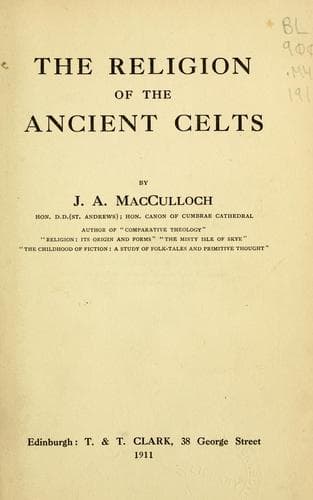
The Religion of the Ancient CeltsMacCulloch, J. A. (John Arnott)
Religion
The Religion of the Ancient Celts
MacCulloch, J. A. (John Arnott)
Celts -- Religion; Mythology, Celtic
Images of the gods in Gaul can be classified by means of their
symbols--the mallet and cup (a symbol of plenty) borne by the god with
the hammer, the wheel of the sun-god, the cornucopia and torque carried
by Cernunnos. Other symbols occur on images, altars, monuments, and
coins. These are the swastika and triskele, probably symbols of the
sun;[991] single or concentric circles, sometimes with rays;[992]
crosses; and a curious S figure. The triskele and the circles are
sometimes found on faces figured on coins. They may therefore have been
tattoo markings of a symbolic character. The circle and cross are often
incised on bronze images of Dispater. Much speculation has been aroused
by the S figure, which occurs on coins, while nine models of this symbol
hang from a ring carried by the god with the wheel, but the most
probable is that which sees in it a thunderbolt.[993] But lacking any
old text interpreting these various symbols, all explanations of them
must be conjectural. Some of them are not purely Celtic, but are of
world-wide occurrence.
CULT OF WEAPONS.
Here some reference may be made to the Celtic cult of weapons. As has
been seen, a hammer is the symbol of one god, and it is not unlikely
that a cult of the hammer had preceded that of the god to whom the
hammer was given as a symbol. Esus is also represented with an axe. We
need not repeat what has already been said regarding the primitive and
universal cult of hammer or axe,[994] but it is interesting to notice,
in connection with other evidence for a Celtic cult of weapons, that
there is every reason to believe that the phrase _sub ascia dedicare_,
which occurs in inscriptions on tombs from Gallia Lugdunensis, usually
with the figure of an axe incised on the stone, points to the cult of
the axe, or of a god whose symbol the axe was.[995] In Irish texts the
power of speech is attributed to weapons, but, according to the
Christian scribe, this was because demons spoke from them, for the
people worshipped arms in those days.[996] Thus it may have been
believed that spirits tenanted weapons, or that weapons had souls.
Evidence of the cult itself is found in the fact that on Gaulish coins a
sword is figured, stuck in the ground, or driving a chariot, or with a
warrior dancing before it, or held in the hand of a dancing
warrior.[997] The latter are ritual acts, and resemble that described by
Spenser as performed by Irish warriors in his day, who said prayers or
incantations before a sword stuck in the earth.[998] Swords were also
addressed in songs composed by Irish bards, and traditional remains of
such songs are found in Brittany.[999] They represent the chants of the
ancient cult. Oaths were taken by weapons, and the weapons were believed
to turn against those who lied.[1000] The magical power of weapons,
especially of those over which incantations had been said, is frequently
referred to in traditional tales and Irish texts.[1001] A reminiscence
Public-domain text, read in full here on John Shaqi.
Reviews
Reviews
No reviews yet
Be the first to share your thoughts on this work.
Elsewhere in the archive
Join the Discussion
Join the discussion
Sign in to leave a comment or review.
Sign InorCreate an account