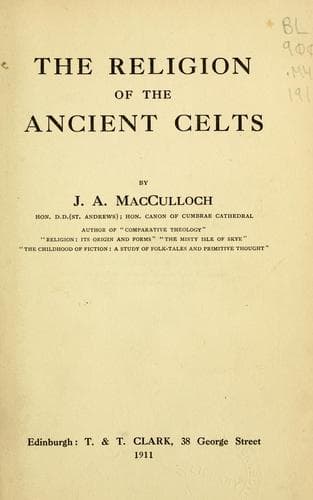
The Religion of the Ancient CeltsMacCulloch, J. A. (John Arnott)
Religion
The Religion of the Ancient Celts
MacCulloch, J. A. (John Arnott)
Celts -- Religion; Mythology, Celtic
Our supposition that the _gutuatri_ were a class of Druids is supported
by classical evidence, which tends to show that the Druids were a great
inclusive priesthood with different classes possessing different
functions--priestly, prophetic, magical, medical, legal, and poetical.
Cæsar attributes these to the Druids as a whole, but in other writers
they are in part at least in the hands of different classes. Diodorus
refers to the Celtic philosophers and theologians (Druids), diviners,
and bards, as do also Strabo and Timagenes, Strabo giving the Greek form
of the native name for the diviners, [Greek: ouateis], the Celtic form
being probably _vátis_ (Irish, _fáith_).[1018] These may have been also
poets, since _vátis_ means both singer and poet; but in all three
writers the bards are a fairly distinct class, who sing the deeds of
famous men (so Timagenes). Druid and diviner were also closely
connected, since the Druids studied nature and moral philosophy, and the
diviners were also students of nature, according to Strabo and
Timagenes. No sacrifice was complete without a Druid, say Diodorus and
Strabo, but both speak of the diviners as concerned with sacrifice.
Druids also prophesied as well as diviners, according to Cicero and
Tacitus.[1019] Finally, Lucan mentions only Druids and bards.[1020]
Diviners were thus probably a Druidic sub-class, standing midway between
the Druids proper and the bards, and partaking of some of the functions
of both. Pliny speaks of "Druids and this race of prophets and
doctors,"[1021] and this suggests that some were priests, some diviners,
while some practised an empiric medical science.
On the whole this agrees with what is met with in Ireland, where the
Druids, though appearing in the texts mainly as magicians, were also
priests and teachers. Side by side with them were the _Filid_, "learned
poets,"[1022] composing according to strict rules of art, and higher
than the third class, the Bards. The _Filid_, who may also have been
known as _Fáthi_, "prophets,"[1023] were also diviners according to
strict rules of augury, while some of these auguries implied a
sacrifice. The Druids were also diviners and prophets. When the Druids
were overthrown at the coming of Christianity, the _Filid_ remained as a
learned class, probably because they had abandoned all pagan practices,
while the Bards were reduced to a comparatively low status. M. D'Arbois
supposes that there was rivalry between the Druids and the _Filid_, who
made common cause with the Christian missionaries, but this is not
supported by evidence. The three classes in Gaul--Druids, _Vates_, and
Bards--thus correspond to the three classes in Ireland--Druids, _Fáthi_
or _Filid_, and Bards.[1024]
Public-domain text, read in full here on John Shaqi.
Reviews
Reviews
No reviews yet
Be the first to share your thoughts on this work.
Elsewhere in the archive
Join the Discussion
Join the discussion
Sign in to leave a comment or review.
Sign InorCreate an account