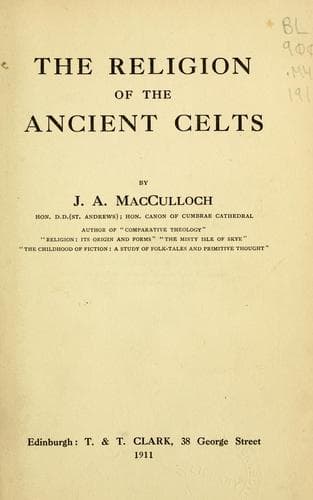
The Religion of the Ancient CeltsMacCulloch, J. A. (John Arnott)
Religion
The Religion of the Ancient Celts
MacCulloch, J. A. (John Arnott)
Celts -- Religion; Mythology, Celtic
That political power must have been enhanced by their position as
teachers, and it is safe to say that submission to their powers was
inculcated by them. Both in Gaul and in Ireland they taught others than
those who intended to become Druids.[1049] As has been seen, their
teachings were not written down, but transmitted orally. They taught
immortality, believing that thus men would be roused to valour,
buttressing patriotism with dogma. They also imparted "many things
regarding the stars and their motions, the extent of the universe and
the earth, the nature of things, and the power and might of the immortal
gods." Strabo also speaks of their teaching in moral science.[1050] As
has been seen, it is easy to exaggerate all this. Their astronomy was
probably of a humble kind and mingled with astrology; their natural
philosophy a mass of cosmogonic myths and speculations; their theology
was rather mythology; their moral philosophy a series of maxims such as
are found in all barbaric communities. Their medical lore, to judge from
what Pliny says, was largely magical. Some Druids, e.g. in the south of
Gaul, may have had access to classical learning, and Cæsar speaks of the
use of Greek characters among them. This could hardly have been general,
and in any case must have superseded the use of a native script, to
which the use of ogams in Ireland, and perhaps also in Gaul, was
supplementary. The Irish Druids may have had written books, for King
Loegaire desired that S. Patrick's books and those of the Druids should
be submitted to the ordeal by water as a test of their owners'
claims.[1051]
In religious affairs the Druids were supreme, since they alone "knew the
gods and divinities of heaven."[1052] They superintended and arranged
all rites and attended to "public and private sacrifices," and "no
sacrifice was complete without the intervention of a Druid."[1053] The
dark and cruel rites of the Druids struck the Romans with horror, and
they form a curious contrast to their alleged "philosophy." They used
divination and had regular formulæ of incantation as well as ritual acts
by which they looked into the future.[1054] Before all matters of
importance, especially before warlike expeditions, their advice was
sought because they could scan the future.
Public-domain text, read in full here on John Shaqi.
Reviews
Reviews
No reviews yet
Be the first to share your thoughts on this work.
Elsewhere in the archive
Join the Discussion
Join the discussion
Sign in to leave a comment or review.
Sign InorCreate an account