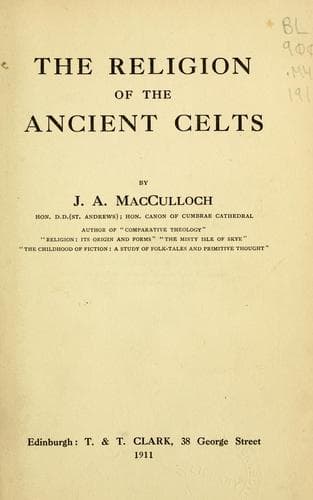
The Religion of the Ancient CeltsMacCulloch, J. A. (John Arnott)
Religion
The Religion of the Ancient Celts
MacCulloch, J. A. (John Arnott)
Celts -- Religion; Mythology, Celtic
[1141] _Rev. Arch._ i. 227; Greenwell, _British Barrows_, 165; Elton,
66; Renel, 95f., 194f.
[1142] Reinach, _BF_ 286, 289, 362.
[1143] O'Curry, _MS Mat._ 387. See a paper by Hartland, "The Voice of
the Stone of Destiny," _Folk-lore Journal_, xiv. 1903.
[1144] Petrie, _Trans. Royal Irish Acad._ xviii. pt. 2.
[1145] O'Curry, _MS. Mat._ 393 f.
[1146] Sébillot, i. 334 f.
[1147] Trollope, _Brittany_, ii. 229; Bérenger-Féraud, _Superstitions et
Survivances_, i. 529 f.; Borlase, _Dolmens of Ireland_, iii. 580, 689,
841 f.
[1148] _Rev. des Trad._ 1894, 494; Bérenger-Féraud, i. 529, ii. 367;
Elworthy, _Evil Eye_, 70.
[1149] Bérenger-Féraud, i. 523; Elworthy, 69, 106; Reinach,
_L'Anthropologie_, iv. 33.
[1150] Kennedy, 324; Adamnan, _Vita S. Col._ ii. 35.
[1151] Life of S. Fechin of Fore, _RC_ xii. 333; Life of S. Kieran,
O'Grady, ii. 13; Amra Cholumbchille, _RC_ xx. 41; Life of S. Moling,
_RC_ xxvii. 293; and other lives _passim_. See also Plummer, _Vitæ
Sanctorum Hiberniæ_.
[1152] Adamnan, ii. 34. This pebble was long preserved, but mysteriously
disappeared when the person who sought it was doomed to die.
[1153] Wodrow, _Analecta_, _passim_; Walker, _Six Saints of the
Covenant_, ed. by Dr. Hay Fleming.
CHAPTER XXII.
THE STATE OF THE DEAD.
Among all the problems with which man has busied himself, none so
appeals to his hopes and fears as that of the future life. Is there a
farther shore, and if so, shall we reach it? Few races, if any, have
doubted the existence of a future state, but their conceptions of it
have differed greatly. But of all the races of antiquity, outside Egypt,
the Celts seem to have cherished the most ardent belief in the world
beyond the grave, and to have been preoccupied with its joys. Their
belief, so far as we know it, was extremely vivid, and its chief
characteristic was life in the body after death, in another
region.[1154] This, coupled with the fact that it was taught as a
doctrine by the Druids, made it the admiration of classical onlookers.
But besides this belief there was another, derived from the ideas of a
distant past, that the dead lived on in the grave--the two conceptions
being connected. And there may also have been a certain degree of belief
in transmigration. Although the Celts believed that the soul could exist
apart from the body, there seems to be no evidence that they believed in
a future existence of the soul as a shade. This belief is certainly
found in some late Welsh poems, where the ghosts are described as
wandering in the Caledonian forest, but these can hardly be made use of
as evidence for the old pagan doctrine. The evidence for the latter may
be gathered from classical observers, from archæology and from Irish
texts.
Public-domain text, read in full here on John Shaqi.
Reviews
Reviews
No reviews yet
Be the first to share your thoughts on this work.
Elsewhere in the archive
Join the Discussion
Join the discussion
Sign in to leave a comment or review.
Sign InorCreate an account