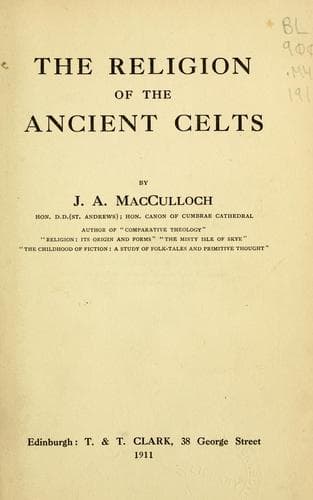
The Religion of the Ancient CeltsMacCulloch, J. A. (John Arnott)
Religion
The Religion of the Ancient Celts
MacCulloch, J. A. (John Arnott)
Celts -- Religion; Mythology, Celtic
The archæological evidence of burial customs among the Celts also bears
witness to this belief. Over the whole Celtic area a rich profusion of
grave-goods has been found, consisting of weapons, armour, chariots,
utensils, ornaments, and coins.[1163] Some of the interments undoubtedly
point to sacrifice of wife, children, or slaves at the grave. Male and
female skeletons are often in close proximity, in one case the arm of
the male encircling the neck of the female. In other cases the remains
of children are found with these. Or while the lower interment is richly
provided with grave-goods, above it lie irregularly several skeletons,
without grave-goods, and often with head separated from the body,
pointing to decapitation, while in one case the arms had been tied
behind the back.[1164] All this suggests, taken in connection with
classical evidence regarding burial customs, that the future life was
life in the body, and that it was a _replica_ of this life, with the
same affections, needs, and energies. Certain passages in Irish texts
also describe burials, and tell how the dead were interred with
ornaments and weapons, while it was a common custom to bury the dead
warrior in his armour, fully armed, and facing the region whence enemies
might be expected. Thus he was a perpetual menace to them and prevented
their attack.[1165] Possibly this belief may account for the elevated
position of many tumuli. Animals were also sacrificed. Hostages were
buried alive with Fiachra, according to one text, and the wives of
heroes sometimes express their desire to be buried along with their dead
husbands.[1166]
The idea that the body as well as the soul was immortal was probably
linked on to a very primitive belief regarding the dead, and one shared
by many peoples, that they lived on in the grave. This conception was
never forgotten, even in regions where the theory of a distant land of
the dead was evolved, or where the body was consumed by fire before
burial. It appears from such practices as binding the dead with cords,
or laying heavy stones or a mound of earth on the grave, probably to
prevent their egress, or feeding the dead with sacrificial food at the
grave, or from the belief that the dead come forth not as spirits, but
in the body from the grave. This primitive conception, of which the
belief in a subterranean world of the dead is an extension, long
survived among various races, e.g. the Scandinavians, who believed in
the barrow as the abiding place of the dead, while they also had their
conception of Hel and Valhalla, or among the Slavs, side by side with
Christian conceptions.[1167] It also survived among the Celts, though
another belief in the _orbis alius_ had arisen. This can be shown from
modern and ancient folk-belief and custom.
Public-domain text, read in full here on John Shaqi.
Reviews
Reviews
No reviews yet
Be the first to share your thoughts on this work.
Elsewhere in the archive
Join the Discussion
Join the discussion
Sign in to leave a comment or review.
Sign InorCreate an account