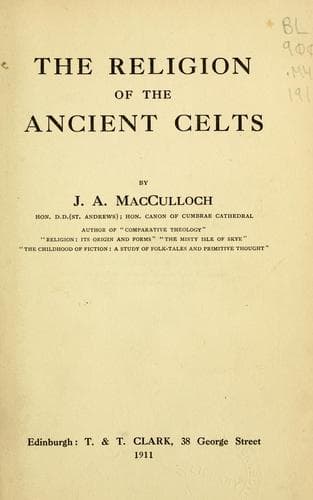
The Religion of the Ancient CeltsMacCulloch, J. A. (John Arnott)
Religion
The Religion of the Ancient Celts
MacCulloch, J. A. (John Arnott)
Celts -- Religion; Mythology, Celtic
The mythological cycle is not a complete "body of divinity"; its
apparent completeness results from the chronological order of the
annalists. Fragments of other myths are found in the _Dindsenchas_;
others exist as romantic tales, and we have no reason to believe that
all the old myths have been preserved. But enough remains to show the
true nature of the Tuatha Dé Danann--their supernatural character, their
powers, their divine and unfailing food and drink, their mysterious and
beautiful abode. In their contents, their personages, in the actions
that are described in them, the materials of the "mythological cycle,"
show how widely it differs from the Cúchulainn and Fionn cycles.[198]
"The white radiance of eternity" suffuses it; the heroic cycles, magical
and romantic as they are, belong far more to earth and time.
FOOTNOTES:
[153] For some Highland references to the gods in saga and _Märchen_,
see _Book of the Dean of Lismore_, 10; Campbell, _WHT_ ii. 77. The
sea-god Lir is probably the Liur of Ossianic ballads (Campbell, _LF_
100, 125), and his son Manannan is perhaps "the Son of the Sea" in a
Gaelic song (Carmichael, _CG_ ii. 122). Manannan and his daughters are
also known (Campbell, _witchcraft_, 83).
[154] The euhemerising process is first seen in tenth century poems by
Eochaid hua Flainn, but was largely the work of Flainn Manistrech, _ob._
1056. It is found fully fledged in the _Book of Invasions_.
[155] Keating, 105-106.
[156] Keating, 107; _LL_ 4_b_. Cf. _RC_ xvi. 155.
[157] _LL_ 5.
[158] Keating, 111. Giraldus Cambrensis, _Hist. Irel._ c. 2, makes
Roanus survive and tell the tale of Partholan to S. Patrick. He is the
Caoilte mac Ronan of other tales, a survivor of the Fians, who held many
racy dialogues with the Saint. Keating abuses Giraldus for equating
Roanus with Finntain in his "lying history," and for calling him Roanus
instead of Ronanus, a mistake in which he, "the guide bull of the herd,"
is followed by others.
[159] Keating, 164.
[160] _LL_ 5_a_.
[161] Keating, 121; _LL_ 6_a_; _RC_ xvi. 161.
[162] Nennius, _Hist. Brit._ 13.
[163] _LL_ 6, 8_b_.
[164] _LL_ 6_b_, 127_a_; _IT_ iii. 381; _RC_ xvi. 81.
[165] _LL_ 9_b_, 11_a_.
[166] See Cormac, _s.v._ "Nescoit," _LU_ 51.
[167] _Harl. MSS._ 2, 17, pp. 90-99. Cf. fragment from _Book of
Invasions_ in _LL_ 8.
[168] _Harl. MS._ 5280, translated in _RC_ xii. 59 f.
[169] _RC_ xii. 60; D'Arbois, v. 405 f.
[170] For Celtic brother-sister unions see p. 224.
[171] O'Donovan, _Annals_, i. 16.
[172] _RC_ xv. 439.
[173] _RC_ xii. 71.
[174] Professor Rh[^y]s thinks the Partholan story is the aboriginal,
the median the Celtic version of the same event. Partholan, with initial
_p_ cannot be Goidelic (_Scottish Review_, 1890, "Myth. Treatment of
Celtic Ethnology").
[175] _HL_ 591.
[176] _CM_ ix. 130; Campbell _LF_ 68.
[177] _RC_ xii. 75.
[178] _US_ 211.
[179] D'Arbois, ii. 52; _RC_ xii. 476.
[180] _RC_ xii. 73.
[181] _RC_ xii. 105.
[182] _RC_ xxii. 195.
Public-domain text, read in full here on John Shaqi.
Reviews
Reviews
No reviews yet
Be the first to share your thoughts on this work.
Join the Discussion
Join the discussion
Sign in to leave a comment or review.
Sign InorCreate an account